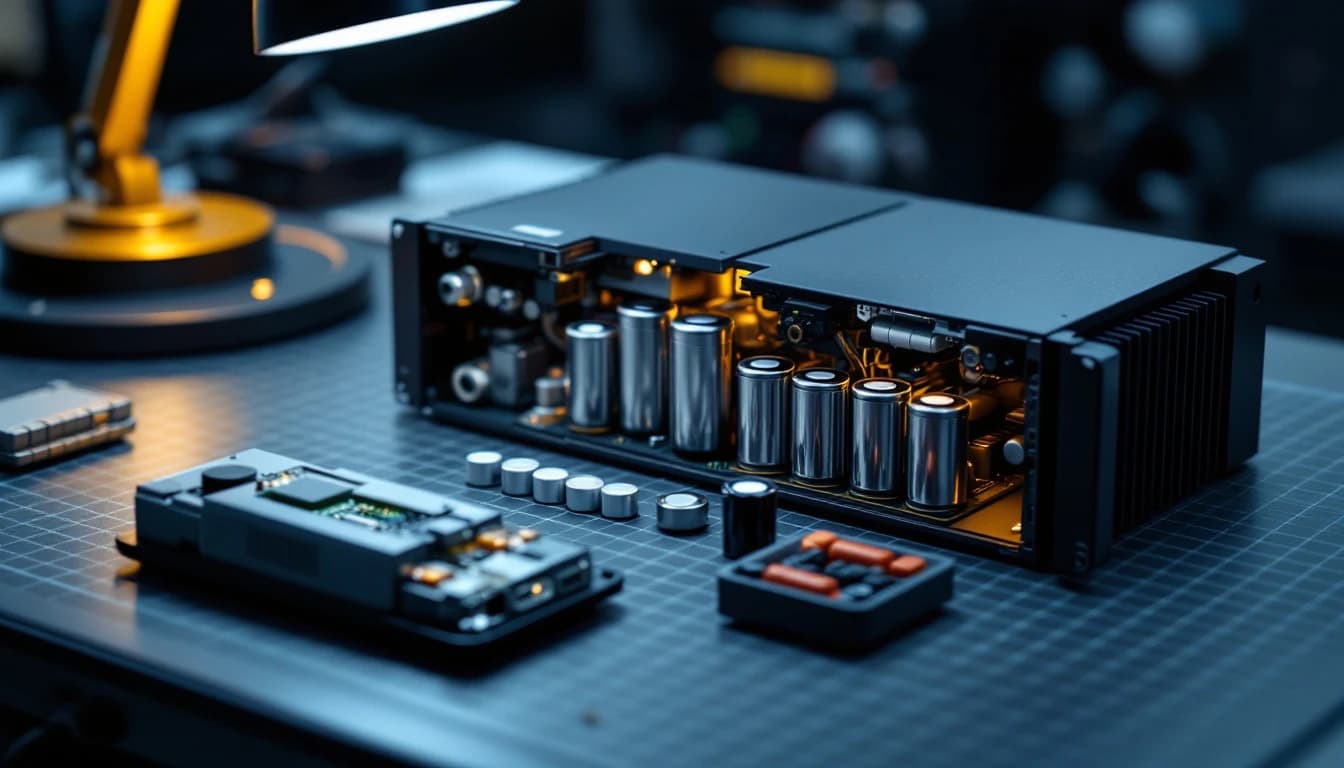
Most servo amplifier repairs land between $400 and $1,500 depending on brand and module size. FANUC alpha and beta amplifiers typically run $650–$1,500, Mitsubishi MR-J series $450–$950, Yaskawa Sigma Servopacks $400–$900, Allen-Bradley Ultra drives $500–$1,100, Indramat drives $600–$1,200 and Siemens SIMODRIVE 611 modules $500–$1,400 — in every case well under the OEM exchange price for the same module. Evaluation is free, the quote is firm before any work, and every repair carries a 24-month warranty.
That is the number most maintenance managers want before they open a purchase requisition. What follows is where those ranges come from, the four variables that actually move a quote inside them, and the honest cases where repair is the wrong answer.
The price table
As of September 2026 these are our documented repair ranges by drive family. Servo amplifiers are quote-track rather than flat-price for a reason explained below — the range is what we have historically charged, and the firm number always comes from the bench evaluation.
| Drive family | Typical catalog numbers | Typical repair | Versus the OEM path |
|---|---|---|---|
| FANUC alpha / alpha i / beta servo amplifier | A06B-6079, -6096, -6114, -6117, -6130 | $650–$1,500 | OEM exchange units quoted from $2,500 |
| FANUC spindle amplifier (SPM) | A06B-6078, -6088, -6111, -6121 | $750–$1,800 | OEM exchange where still offered |
| FANUC power supply module (PSM) | A06B-6077, -6087, -6110 | $500–$1,200 | OEM exchange where still offered |
| Mitsubishi MR-J2S / MR-J3 / MR-J4, MDS | MR-J2S, MR-J3, MR-J4 series | $450–$950 | OEM support ended on older MR-J2S |
| Yaskawa Sigma / Sigma-II / Sigma-5 | SGD, SGDM, SGDH, SGDV | $400–$900 | OEM replacement is a generation migration |
| Allen-Bradley Ultra 3000 / Ultra 100-200 | 2098-DSD series | $500–$1,100 | OEM line discontinued, Kinetix migration |
| Indramat / Bosch Rexroth | DKC, DDS, HDS, TDM, KDS | $600–$1,200 | No OEM service path remains |
| Siemens SIMODRIVE 611 axis + control card | 6SN1123, 6SN1118 | $500–$1,400 | OEM replacement is a control retrofit |
| Rush service (any of the above) | — | +$149 | 1–2 business days in lab |
| Emergency bench attempt | — | +$399 | Same / next business day |
Standard turnaround is 3–5 business days in lab once the module arrives. The free bench evaluation comes before all of it: if the fault turns out to live in your motor, encoder or cable rather than the amplifier, we tell you that and you pay nothing.
Why servo amplifiers are quoted, not flat-priced
Our HMI repairs carry flat prices because the failure set is bounded — power supply, touch digitizer, backlight, in that order. Servo amplifiers are not like that. A single part-number family covers modules that differ by an order of magnitude in current rating, and the same alarm can mean a small gate-driver component or a full power-module replacement.
Quoting them flat would mean pricing every repair at the worst case, which is how a plant ends up paying top dollar for a blown fuse and a recap. The evaluation exists so the number reflects what your unit actually needs. Adjustable-speed drive systems are standardised under the IEC 61800 series (iec.ch), and the practical consequence of that standardisation is that the failure modes rhyme across brands even when the pricing does not.
Four things move a quote inside its range:
- Power stage or not. An IGBT or IPM power-module replacement is the expensive end of every range. A control-power supply, gate driver, current sensor or cooling fan is the cheap end. The alarm number usually tells us which before the unit even ships.
- Module size and axis count. A three-axis alpha i module costs more to repair than a single-axis beta, for the obvious reason that there are three of everything inside it.
- Collateral damage. An amplifier that failed because a motor or cable shorted often took the current sensors and gate drivers down with the power stage. That is one repair rather than three, but it sits at the top of the band.
- Scarcity of donor components. Legacy Series 0 and 16/18/21-era FANUC modules and Indramat DDS drives need parts no longer in volume production. We still source them; they cost more.
"The mistake I made for years was treating the amp as the suspect because it was the box with the light on it. Half the time the amp was reporting somebody else's problem — a dragging axis, a chafed feedback cable. Getting an honest bench answer before buying anything changed how we budget."
— Maintenance manager, 22 years, metal stamping; name withheld by request
What a servo amplifier repair actually includes
A component-level repair is not a reset and a wipe-down. On a typical amplifier the bench work is:
- Incoming functional test and fault confirmation against the reported alarm
- IGBT / IPM power-stage replacement with new components where the stage has failed
- Gate-driver, DC-bus and control power-supply repair
- Current-sensor and encoder-interface repair
- Full replacement of aged electrolytic capacitors as standard practice, not only the failed ones
- Powered bench verification appropriate to the module class
- The 24-month warranty
That capacitor policy matters more than it sounds. Electrolytic ageing is chemistry rather than chance: electrolyte escapes through the seal over years of heat, and the widely used Arrhenius guidance is that every 10 °C of sustained temperature rise roughly halves electrolytic life. A drive mounted in a warm cabinet ages on an accelerated schedule, and its neighbours are ageing at the same rate. Replacing only the component that failed leaves the rest of that cohort a year behind it.
One thing that does not need reinstating: your parameters. Servo tuning and axis parameters live in the CNC or motion controller, not in the amplifier, so a repaired module goes back in without reprogramming in nearly all cases.
Repair against the alternatives
The honest comparison is rarely repair against a new module at list price. It is repair against three real options.
OEM exchange. Where it still exists, it is the fastest path and the most expensive. FANUC exchange units are quoted from $2,500 for amplifier classes we repair in the $650–$1,500 band. You also get a different serial number back, which matters inside some quality systems.
Used or surplus. A used amplifier of the same vintage carries the same aged capacitors yours just failed on, typically without a warranty worth the name. It is a reasonable bridge if you need the machine running this afternoon and can repair yours as the spare — which is, in practice, the smartest use of surplus.
Migration. Replacing an obsolete drive generation with a current one means new motors or adapter engineering, parameter work, commissioning time and validation. For a machine that otherwise runs well, that is a project rather than a purchase. The arithmetic is worked through in repair vs. replace: the actual math, and the short version is that migration wins when the machine is near end of life anyway and loses badly when it is not.
Against all three, the variable that dominates is downtime rather than the repair price. ABB's Value of Reliability survey of 3,215 plant-level respondents put average unplanned downtime cost at $125,000 per hour globally. Set any figure in the table above against an hourly number of that magnitude and the interesting question stops being the price and becomes the calendar — which is exactly what rush service exists for.
Before you pull the amplifier
Two practical notes that save both money and hands.
First, lock out and verify. Drive DC-bus capacitors hold lethal charge after the disconnect is opened, and the discharge time is specified by the manufacturer for a reason. The control-of-hazardous-energy requirements (osha.gov) and the industrial machinery electrical practices in NFPA 79 (nfpa.org) both exist because this equipment has killed people who assumed a cabinet was dead because the light was off. Power-conversion equipment safety requirements are likewise defined in the UL 508C lineage (ul.com).
Second, record the alarm before you power down. The alarm number, which axis, what the machine was doing, and any code on the amplifier's own indicator are the difference between a two-hour evaluation and a one-day one. If you are not certain the amplifier is even the guilty party, is it the amplifier or the motor? walks the decision, and for FANUC systems specifically the A06B part-number guide decodes what you are actually holding. Allen-Bradley users will find the same ground covered in Ultra 3000 and Kinetix faults, and Rexroth users in the Indramat part-number guide.
A note on scope, because it is easier to say now than after you have paid freight: a servo amplifier is not a VFD. If the box driving your conveyor is a variable frequency drive rather than a servo amplifier, both the pricing and the failure profile differ — see VFD repair cost and, for ABB units, the ACS fault-code guide.
What we will not pretend to do
Large SIMODRIVE infeed and NE modules above roughly 36 kW need test capacity we do not claim, and we say so at the quote rather than after. Faults living in motor windings, encoders or cabling are identified honestly at evaluation and cost you nothing. And a module whose damage exceeds its economic value gets told that straight, because a shop that repairs everything is a shop that is guessing.
Federal statistics make the background case for repair better than we can. Producer price data for machinery and equipment (bls.gov) has run well above the general index for several years, and the manufacturing capital-expenditure series (census.gov) shows how much of a plant budget is already committed before an unplanned amplifier failure arrives. Repairing the module that failed is usually the only line in that story you still control. When you are ready, start a repair or send the module with our mail-in instructions.
Frequently asked questions
How much does servo amplifier repair cost?
Most repairs fall between $400 and $1,500 depending on brand and module size. FANUC alpha and beta amplifiers typically run $650–$1,500, Mitsubishi MR-J series $450–$950, Yaskawa Sigma Servopacks $400–$900, Allen-Bradley Ultra drives $500–$1,100, Indramat $600–$1,200 and Siemens SIMODRIVE 611 $500–$1,400 — each below the OEM exchange price for the equivalent module. The bench evaluation is free and the quote is firm before any work starts.
Why is the price a range instead of a flat fee?
Because one part-number family can cover modules that differ enormously in current rating, and because the same alarm can mean a small gate-driver repair or a full power-module replacement. A flat price would have to be set at the worst case, so everyone with a simple fault would overpay. The evaluation costs nothing and produces a firm number.
What if it turns out to be the motor and not the amplifier?
Then we tell you, you pay nothing, and you have ruled out the expensive box before spending money on it. Many servo alarms distinguish amplifier faults from feedback and motor faults, and our bench tests the amplifier independently of your machine.
Do I have to reprogram anything after the repair?
In nearly all cases, no. Servo tuning and axis parameters live in the CNC or motion controller rather than in the amplifier, so a repaired module goes back into the machine and runs on the parameters already there.
How long does a servo amplifier repair take?
Standard turnaround is 3–5 business days in lab once the module arrives, plus shipping each way. Rush service is $149 and moves the unit to the front of the queue at 1–2 business days. Emergency service is $399 for a same or next business day bench attempt — contact us first so we can confirm bench availability.
Do you repair obsolete amplifiers the manufacturer no longer supports?
Yes, and it is a large part of what we do. Legacy FANUC Series 0/16/18/21-era amplifiers, Indramat DKC and DDS drives, Mitsubishi MR-J2S and early Yaskawa Sigma Servopacks all have no remaining factory service path. Third-party component-level repair is frequently the only way to keep those machines in production.
What happens if you cannot repair it?
On quote-track repairs like servo amplifiers, nothing has been charged at that point — the evaluation is free and no work proceeds without your written approval, so an unrepairable module costs you return shipping and nothing else.
Have this exact problem?
Start a repair or get a free technician review — we'll tell you honestly whether it's worth fixing.