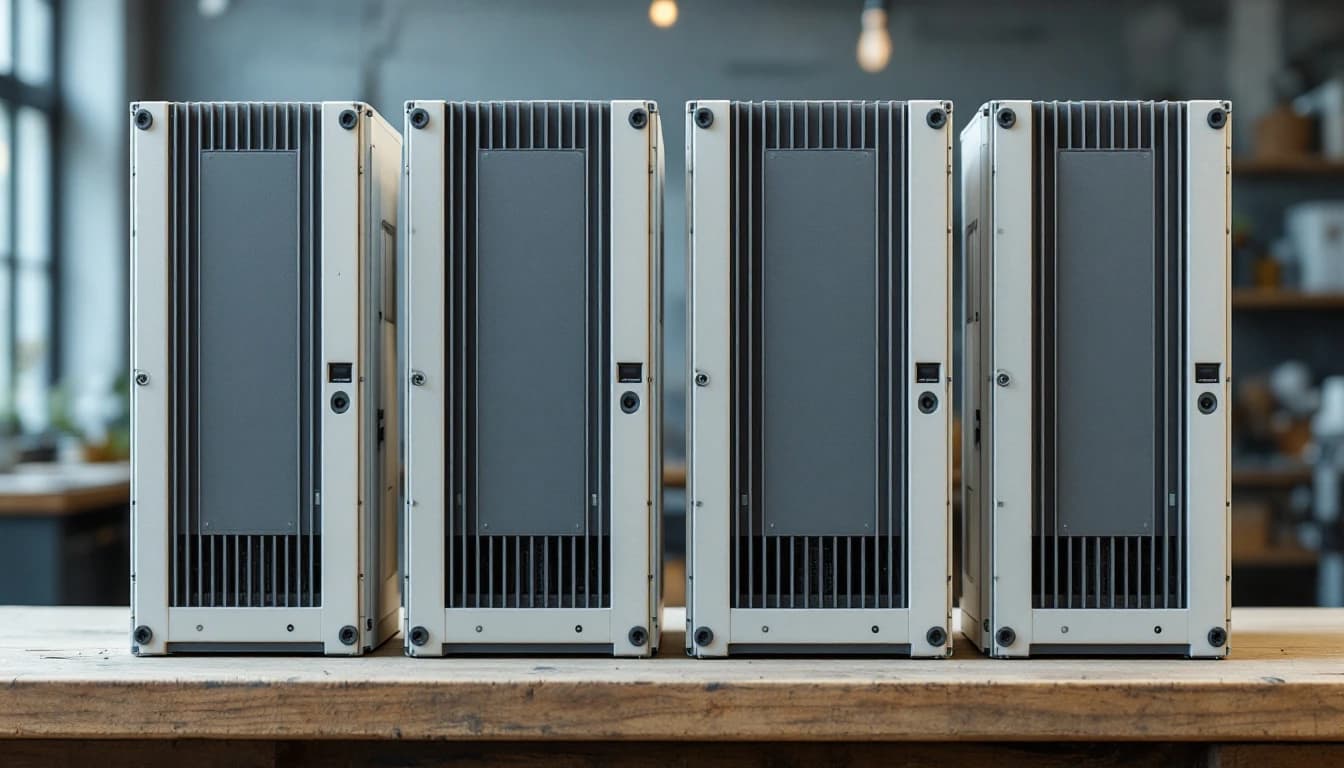
An Indramat or Bosch Rexroth drive part number tells you three things before you do anything else: the family prefix (DKC, DDS, HDS, TDM, KDS) tells you which generation and architecture you have, the numeric block after the dash gives the current rating, and a trailing FW indicates the drive takes a plug-in firmware module that carries your parameters. Get those three right and the rest of the repair conversation is straightforward. Indramat and Rexroth drive repairs run about $600–$1,200 after a free evaluation, with a 24-month warranty.
These drives outlived their OEM support decades ago and are still running presses, packaging lines and machine tools across the country. The part number is the fastest way to establish what you are holding, what still exists for it, and whether repair is the sensible path — which, on this platform, it almost always is.
The family map
As of September 2026, this is how the Indramat and Rexroth drives we see actually sort out. The families are worth learning because they represent genuinely different architectures, not just different sizes.
| Prefix | Family | Architecture | What you typically have | Repair status |
|---|---|---|---|---|
| DKC | Ecodrive | Self-contained digital drive controller with plug-in firmware module | DKC01.3, DKC02.3, DKC03.3 — analog, parallel and SERCOS interface variants | Core repair platform |
| DDS | Digital Drive System | Rack-mounted digital drive on a shared DC bus | DDS02.1 and DDS03.1 in -W025, -W030, -W050, -W100 current ratings | Core repair platform |
| HDS | Higher-power digital drive | Rack-mounted, larger frames than DDS | HDS02 and HDS03 series | Repairable, evaluated per unit |
| TDM | Transistor drive module | Analog rack drive, the generation before DDS | TDM 1.2 and TDM 3 series | Repairable, long EOL |
| KDS | Analog drive | Analog rack drive, contemporary with TDM | KDS 1.3 and siblings | Repairable, long EOL |
| TVD / TVM / KDV | Supply modules | Power supply and bus modules feeding the analog and digital racks | Rack-dependent | Evaluated per unit |
| MAC / MDD / MKD / MHD | Motors | Servo motors matched to the above | — | Motor shop, not a board bench |
That last row matters more than it looks. A large share of "Indramat drive" calls turn out to be motor or feedback problems on an Indramat machine — a different repair discipline entirely, and one where a board-level bench should say so rather than take the drive apart.
Reading a DKC number
Take the number we see most often, DKC01.3-040-7-FW, and read it left to right:
DKC— Ecodrive controller family. This is a self-contained drive, not a rack module, which is a large part of why the platform aged so well.01— the interface variant. The Ecodrive line was built in interface flavours, and the variant digit is what distinguishes an analog-interface unit from a parallel-interface or SERCOS-interface one. Two drives with identical current ratings and different variant digits are not interchangeable..3— the design or hardware revision of that variant.040— the current rating in amps.7— the supply and configuration code.FW— the firmware designation. On this platform the operating firmware and your commissioning parameters ride on a plug-in module rather than being burned into the drive.
That last point is the single most important practical fact about sending an Ecodrive out for repair, so it gets its own section below.
Always verify against the nameplate rather than against memory or a spreadsheet. Indramat and Rexroth produced a very large number of ordering variants over a long production life, and a machine builder's spares list from 1998 is not a reliable source of truth about what is physically in your cabinet today. Photograph the nameplate; it takes five seconds and settles every later question.
The firmware module: leave it installed
On Ecodrive units the firmware module carries the operating firmware and your machine's parameter set. Two consequences follow, and both have cost people real downtime:
Ship the drive with its firmware module still installed. We keep your module with your unit through the entire process, so the drive that comes back is the drive that left, with your parameters intact. A drive returned without its own module is a drive that needs re-commissioning on a running machine.
Do not swap a firmware module into a different drive variant hoping to clone an axis. The module is matched to the drive it was commissioned on. This is the same class of trap as any parameterised drive platform, and it produces faults that look like hardware failures.
If your machine has ever been through a rebuild, the firmware module is also where you find out what firmware version your axes are actually running — which is frequently not what the documentation says.
"The Ecodrives are honestly some of the nicest old iron to work on. They were overbuilt, the failure modes are conventional, and the firmware travels with the unit so you're not fighting a commissioning problem on top of an electrical one. The customers who get burned are the ones who pull the module out and ship the drive bare."
— Drive repair technician, 16 years, machine tool sector; name withheld by request
DDS, HDS, TDM and KDS: rack drives
The rack families are a different proposition from the Ecodrive because they share a DC bus fed by a supply module (the TVD, TVM and KDV units). A few practical implications:
Number your slots before you pull anything. Rack drives are frequently not identical across axes, and a rack reassembled in the wrong order produces a commissioning problem that looks like a repair failure.
A dead rack may be the supply module, not the axis. The same logic that applies to a PLC rack applies here: the shared supply is a single point of failure serving several axes. If more than one axis went down together, suspect the supply first.
The -W block is the current rating. A DDS02.1-W025 is a 25 A frame; -W050 and -W100 are the larger siblings. Matching a replacement on current rating alone is not sufficient — the interface and revision have to match too — but it is where the conversation starts.
TDM and KDS are analog. They predate the digital families and use a fundamentally different control approach. They repair well; the components in an analog drive are, if anything, more conventionally available than in a digital one.
What fails, and what a repair covers
The Indramat failure profile is conventional, which is exactly why the platform repairs so well:
Power stage and gate drivers. Transistor and IGBT stages fail from load events, from shorted motor windings, and from age. This is core bench work.
Control supply and electrolytic capacitors. The supply section carries wet electrolytic capacitors sealed behind a rubber bung, and electrolyte escapes through that seal over decades of heat. Capacitance falls, equivalent series resistance climbs, and the drive starts faulting at enable or under load before it fails outright. The manufacturers' own Arrhenius guidance — every 10 °C of sustained temperature rise roughly halves electrolytic life — explains why the drive in the warm end of the cabinet always goes first. A repair includes a full recap where aging is found, which is why a repaired drive is not a patched old drive so much as a drive with fresh wear items.
Resolver and encoder interface circuitry. Feedback faults traced to the drive rather than the cable or the motor are repairable. Note the ordering there: cable and connector faults are far more common than drive-side interface faults, so check the cable end to end before you condemn electronics.
H1 display fault codes and trips at enable. These are the symptoms that bring most units in, and they resolve to one of the three causes above the large majority of the time.
What a repair does not cover is motor-side and mechanical faults. Those get identified at evaluation and reported honestly rather than quietly written into a drive invoice.
Why repair rather than replace in 2026
Bosch Rexroth's modern IndraDrive family is the functional successor, and for a new machine it is obviously the right answer. For an installed machine it is a migration project, not a swap: different physical form factor, different commissioning tools, different parameter structure, new cabinet layout, and re-commissioning on a machine that currently earns money. On validated processes, add change control to that list.
Against that, a repair returns the exact drive, with the exact firmware module and parameters, in days. Typical repairs run about $600–$1,200 — well below the cost of a like-for-like surplus unit of unknown history, and a small fraction of a rack-level migration. The general framework is in the repair-versus-replace math, and the same reasoning applied to a different obsolete servo platform is in the MR-J2S obsolescence guide.
The surplus market for Indramat is real but thin and inconsistent. A surplus DKC carries the same decades-old capacitors yours just failed from, with no load test, no warranty, and no firmware module matched to your machine. That is a materially worse purchase than a repair with a 24-month warranty behind it.
This pattern is not unique to Indramat — it is the standard shape of an obsolete platform, and it is why a discontinued HMI or a legacy FANUC amplifier rack produces exactly the same conversation.
Context worth having on file
- IEC 61800 is the adjustable-speed electrical power drive systems standard family, including 61800-5-1 for safety requirements and 61800-3 for EMC — the latter explains a surprising share of feedback noise problems on drives of this era.
- OSHA estimates proper control of hazardous energy prevents roughly 120 fatalities and 50,000 injuries a year. These racks hold a substantial DC bus charge after the disconnect opens; wait the discharge time and verify with a meter.
- NFPA 70B became a full standard in 2023, which is steadily pushing plants toward documented condition-based maintenance of exactly this class of legacy equipment.
- The IEEE 493 lineage remains the standard published reference for industrial equipment failure-rate data when a capital case needs defensible numbers.
- NIST SP 800-82 covers industrial control system security; even a decades-old drive is a configuration-controlled asset when it leaves your site.
- The U.S. Department of Energy documents that motor-driven systems consume roughly half of all industrial electricity — the reason motion hardware is never a small line item, however old it is.
Shipping an Indramat drive
Start at start-a-repair for an RMA number and the Arlington lab address. Send the drive with its firmware module installed, plus the fault code shown on the H1 display, the machine it came from, and the axis. Photograph the nameplate and include it. Pack rigid and anti-static — the packing guide covers it. Coverage across the wider platform is on the servo drive repair page, per-part-number detail is in the parts catalogue, and the rest of the manufacturers we cover are on the brands page.
Frequently asked questions
What does the FW suffix on an Indramat part number mean?
It indicates that the drive uses a plug-in firmware module carrying the operating firmware and your commissioned parameters, rather than firmware burned permanently into the drive. Ship the drive with that module installed — it stays with your unit through the whole repair, so the drive comes back running your machine's parameters instead of needing re-commissioning.
How do I tell which Indramat family I have?
Read the prefix on the nameplate. DKC is an Ecodrive self-contained controller, DDS and HDS are rack-mounted digital drives on a shared DC bus, TDM and KDS are the earlier analog rack drives, and TVD, TVM or KDV are supply modules rather than axis drives. Photograph the nameplate rather than relying on a machine builder's spares list, which is often decades out of date.
Rexroth says my Indramat drive is beyond end-of-life. Is repair safe?
Yes. These drives were built to industrial standards that repair exceptionally well — power stages, control supplies and capacitors are all serviceable with quality modern components. Repair is how most of the installed base has stayed running since OEM support ended, and a completed repair carries a 24-month warranty.
How much does Indramat or Rexroth drive repair cost?
Units are evaluated free and quoted firm before any work, with typical repairs around $600–$1,200. That covers power-stage and gate-driver repair, control supply repair and a full recap where aging is found, and feedback interface work traced to the drive. Rush service is $149 for 1–2 business day turnaround and emergency bench attempts are $399.
Can I swap a firmware module from one drive into another?
No — the module is matched to the drive it was commissioned on, and moving it between units produces faults that convincingly imitate hardware failures. If you are trying to bring a spare online, the correct path is commissioning it properly rather than cloning a module across variants.
Several axes went down at once. Is that several drive failures?
Almost certainly not. On the DDS, HDS, TDM and KDS rack families the axes share a DC bus fed by a common supply module, so a supply failure takes down everything it feeds. Check the supply module before you condemn multiple drives, and number the slots before you pull anything so the rack goes back the way it came out.
Do you repair the motors as well as the drives?
No — MAC, MDD, MKD and MHD motors are a motor-shop discipline rather than board-level bench work, and we identify motor-side faults at evaluation and say so plainly. Repairing a drive without fixing a shorted winding first would destroy the new output stage on the first run, so that honesty is protective rather than merely tidy.
Have this exact problem?
Start a repair or get a free technician review — we'll tell you honestly whether it's worth fixing.