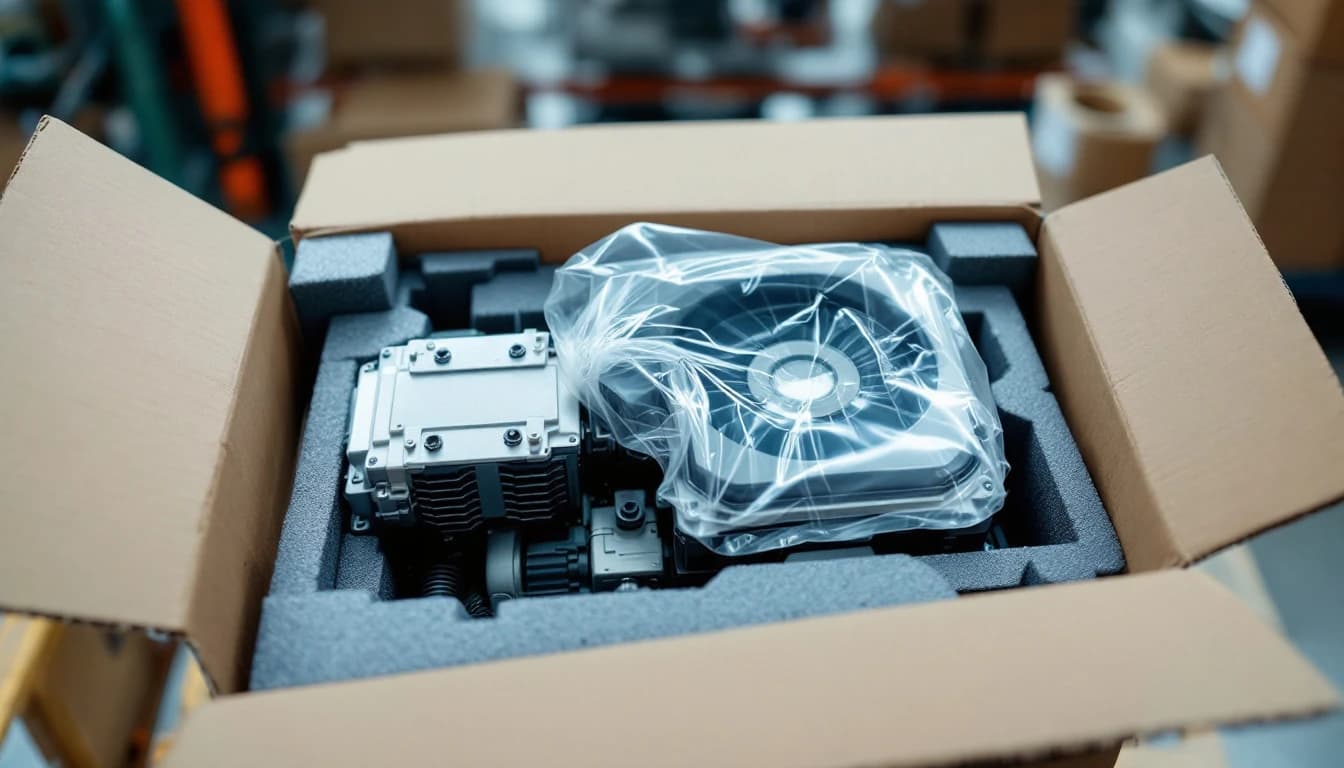
Every mail-in lab has the same heartbreaker: a unit that left the plant repairable and arrived worse. Carriers stack, drop, and compress boxes with total democratic indifference to what's inside. The good news — packing that survives is cheap and takes ten minutes. Here's the method we wish every inbound box used.
The physics you're fighting
Parcel networks subject packages to drops from waist height, 200+ lb stacking loads, and vibration for days. Damage happens three ways: shock (the unit hits the box wall), compression (the box crushes onto the unit), and loose-parts abrasion (something unsecured rattling against a screen for 800 miles). All three are solved by one principle: the unit must float, immobilized, in the middle of a box that can take the hit.
The method
1. Anti-static first (bare boards). Any exposed PCB — a FANUC A16B/A20B board, a PLC module out of its housing — goes in an anti-static bag before anything else. Never let foam peanuts touch bare electronics; they're static generators and they wedge into connectors.
2. Protect the glass. For HMIs, lay a foam sheet or several layers of bubble wrap across the face, then wrap the whole unit. The screen should never be able to contact a box wall, even through padding. Face the screen away from the likely impact side — pack it screen-up relative to the box's natural resting position.
3. Two inches of firm padding, every side. Bubble wrap, foam, or tightly crumpled kraft paper — firm is the operative word. Squishy loose fill compresses to nothing under a drop. The shake test: close the box and shake it hard. Any movement or thud = repack.
4. Double-box anything heavy. Servo drives and power supplies over ~15 lb: wrap and pad into a snug inner box, then float that inner box in 2" of padding inside a larger outer box. A heavy drive in a single box will migrate through padding over a two-day ride.
5. Nothing loose, minimal extras. Don't ship cables, brackets, doors, or hardware unless asked — every extra object is a projectile. A note inside with your RMA, name, and one-line failure description is the only loose item that belongs there. (Indramat owners: leave the firmware module installed — that's the exception.)
6. Tape like you mean it. All seams, H-pattern, real packing tape. Write the RMA large on two sides of the box.
Packing by unit type
| What you are shipping | Method | The mistake that kills it |
|---|---|---|
| HMI / touchscreen panel | Face padded, screen up, 2" firm padding all round | Screen reaching a box wall through soft fill |
| Servo drive or VFD under ~15 lb | Wrap, pad, single strong box | Loose heat-sink fins punching through thin cardboard |
| Servo drive / power supply over ~15 lb | Double-boxed, inner box floated in 2" padding | Single-boxing — heavy units migrate through padding |
| Bare board (FANUC A16B/A20B, PLC module) | Anti-static bag FIRST, then rigid sandwich, then box | Foam peanuts against bare electronics |
| Indramat/Ecodrive | As above, firmware module left INSTALLED | Removing the module "for safekeeping" |
| CNC control board | Parameters backed up, photos taken, anti-static bag | Shipping the only copy of the parameters inside it |
The ESD part everyone skips
Static discharge damage is invisible at the packing bench and expensive at ours: a board that took a discharge can pass initial test and fail weeks after reinstall, which is the worst possible failure mode for everyone. The discipline that prevents it is a solved problem — the industrial ESD control standards maintained through ANSI and the IEC 61340 family exist because ordinary handling generates thousands of volts a human never feels, and a few hundred can wound a semiconductor junction.
For packing purposes the whole standard collapses to three rules. Bare boards go in a proper anti-static bag — the shielding kind, not a pink poly sleeve and never a kitchen freezer bag. Nothing conductive or static-generating touches an exposed connector, which is specifically why foam peanuts are banned near bare electronics. And handle boards by their edges before bagging, away from carpet, on a day you are not wearing the fleece. Complete units in their housings are far more forgiving — the enclosure is the protection — which is one more argument for shipping the whole assembly rather than extracting boards.
Two habits from the freight world finish the job. Weigh honestly and label orientation — the Bureau of Labor Statistics injury tables are full of what happens when a 55 lb drive arrives in a box labelled nothing, and warehouse teams treat unlabelled weight carelessly because they cannot see it. And if the unit came off a machine with a suspected electrical fault, note it: a burned board has told a story with its smell, and intake photographs per OSHA-style incident discipline — before, during, after — are as useful to your insurance narrative as to our diagnosis. The NIST handling guidance for electronic assemblies says the quiet part plainly: most transit damage is decided before the box is sealed.
Insurance and carriers
Insure the shipment for the unit's used replacement value — a $30 insurance line on a $1,500 drive is the cheapest risk transfer you'll ever buy, and carriers only honor claims on insured, demonstrably well-packed boxes (photograph your packing before sealing; it takes ten seconds and wins claims).
Any carrier works to our lab: USPS to the PO Box; UPS/FedEx to the street-address form of the same box — both are on the mail-in instructions page and your RMA confirmation. Machine down? Overnight it with rush service and it hits the bench the day it lands.
The pre-ship checklist
- RMA obtained online, written on box + note inside
- Photos of wiring/connectors taken before removal (for your reinstall)
- CNC parameters backed up (if a control board is leaving the machine)
- Anti-static bag on bare boards
- Screen faced and padded, 2" firm padding all around, shake test passed
- Heavy unit double-boxed
- Insured, tracking number sent to us by replying to your confirmation email
Ten minutes of packing protects the repair, the schedule, and the four-figure unit. Cheap win.
What happens at our end when it arrives
As of August 2026, a unit that arrives properly packed goes straight to intake, gets photographed, and enters the bench queue at a standard 3 to 5 business days in lab. A unit that arrives damaged gets photographed too, and then we have a conversation with you about a carrier claim before any repair work starts, which is time nobody wanted to spend.
Rush service at $149 moves the bench time to 1 to 2 business days. Emergency service at $399 is a same or next business day attempt and needs a call first. Completed repairs carry a 24-month warranty. Start the process on the start a repair page, or use request a quote if you want a technician to look at the symptom before you commit to shipping anything.
If you are still deciding whether the unit is worth sending at all, the repair versus replace math is the honest version of that calculation.
Frequently asked questions
Do I need an RMA number before I ship?
Yes, and it is the single most common omission. An unlabelled box arriving with no paperwork cannot be matched to a customer, a symptom or a machine, so it sits on the receiving bench instead of going to a technician. Get the RMA online first, write it on the outside of the carton, and put a copy on a note inside in case the label is damaged in transit.
How much padding is actually enough?
Two inches of firm padding on every face, including underneath, and the unit must not move when you shake the sealed box. Loose fill that lets the unit migrate to a corner during transit is worse than no padding, because it concentrates every impact on one edge. Heavy units should be double-boxed with padding between the two cartons.
Should I ship the whole assembly or just the board?
Send the complete unit unless we have specifically asked for a bare board. A board removed by someone unfamiliar with the assembly frequently arrives with damaged connectors or missing hardware, and the complete unit lets us functionally test the repair rather than guess at it. If a bare board is unavoidable, it goes in an antistatic bag before it goes anywhere near foam.
Do I need to back anything up before sending a control board?
Yes. Back up CNC parameters, drive parameter files and any machine configuration before the unit leaves the machine, and photograph the wiring and connectors while everything is still in place. Those photographs are for your reinstall, and people are consistently glad they took them.
Should I insure the shipment?
Insure it for the replacement value of the unit, not the repair cost. The repair is a few hundred dollars; the hardware in the box is frequently a four-figure item with a long lead time, and that is the exposure a carrier claim has to cover. Send us the tracking number by replying to your confirmation email so we know what to expect and when.
What box should I actually use?
A new double-walled carton, or visibly sturdy single-wall for light units — never the softened box from the last three shipments, because corrugated loses a large share of its crush strength once its corners have been through a parcel network. Size it so the unit plus two inches of padding on every face fits snugly: an oversized box invites void-fill that compresses, an undersized one puts the unit against the wall it must never touch. For anything heavy, the inner-box-plus-outer-box arrangement beats any amount of padding in a single carton.
Can I reuse the packaging you send the repaired unit back in?
Yes, and it is a genuinely good idea for the next shipment — our outbound packing is built to the same method this guide describes, so keeping the carton and foam gives you a proven-fit kit for that unit family. Inspect it first the way you would any box: crushed corners or soft walls mean it has spent its strength, and the unit deserves fresh corrugated more than you deserve the shelf space back.
What happens if it arrives damaged anyway?
We photograph it on arrival, before anything is opened further, and contact you the same day. Those photographs plus the original packing are what a carrier claim depends on, so nothing is unpacked further until you have decided how to proceed. This is also why the shake test matters: a box that passed it and still arrived damaged is a clean claim.
Have this exact problem?
Start a repair or get a free technician review — we'll tell you honestly whether it's worth fixing.