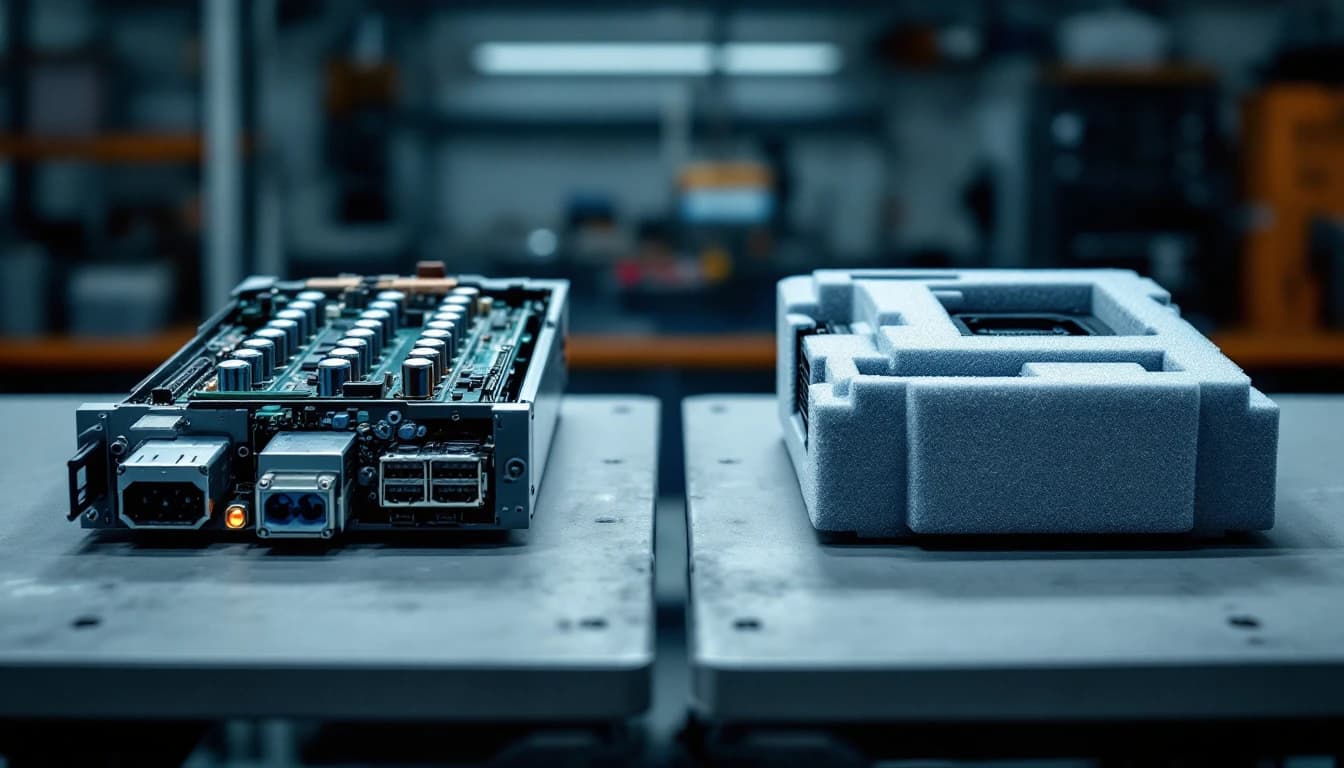
"Just buy a new one" was reasonable advice in 2015. Three numbers explain why plants increasingly repair instead — and when replacing is still right. The short version: downtime cost dwarfs hardware cost, replacement lead times are measured in weeks while repairs are measured in days, and a growing share of the installed base is discontinued hardware with no new unit available at any price. When any of those three applies, repair wins; when none does, replacement is often the honest answer. As of August 2026, here is the full arithmetic, with sources.
Number 1: What an hour of downtime costs
ABB's 2023 Value of Reliability survey (3,215 plant-level respondents) put unplanned downtime at an average of $125,000 per hour globally — about $103,000 per hour for US respondents. Siemens' True Cost of Downtime 2024 report goes further for heavy industry: automotive plants losing $2.3 million per hour. Even if your operation runs at a tiny fraction of those figures, the arithmetic dominates every other number in this decision: the difference between a 4-day repair and a 4-week replacement lead time is measured in multiples of the hardware cost.
That's why the speed of the path back to production — not the invoice — is the first-order term. It is also why the rush ($149) and emergency ($399) tiers on a repair exist at all: against a five-figure hourly downtime number, paying to jump the bench queue is the cheapest decision of the week.
Two more context points sharpen the stakes. DOE motor-system research attributes close to 70% of manufacturing electricity consumption to motor-driven systems — the drives, amplifiers and controls this decision covers are the working end of most of a plant's energy and output. And the population exposed to the problem is not small: BLS counts roughly 12.8 million U.S. manufacturing employees across Census-counted establishments numbering in the hundreds of thousands, the large majority of them small and mid-sized plants without a spare-everything budget.
Number 2: What replacements actually cost and when they arrive
The sticker is only the start:
- Lead time. Post-2021 supply chains never fully snapped back for industrial electronics — drives and HMIs still routinely quote weeks, with industrial HMI lead times reported at 12–16 weeks during 2025's tariff and component crunches.
- The configuration project. A new HMI needs the application converted and loaded; a new drive needs parameters, tuning, and often firmware alignment; a new PLC module wants the right revision. That's engineering hours plus a commissioning window — and on validated lines (food, pharma), a change-control process on top.
- The discontinued trap. For PanelView Plus 6, PLC-5, SLC 500, Simodrive 611, Indramat, and legacy FANUC, there is no new unit at any price. The "replacement" is either a used gamble or a migration project measured in tens of thousands.
Repair, by contrast, is typically 15–50% of replacement cost (the range repair vendors and market data consistently show) and returns the same configured unit — no conversion, no re-validation, no revision roulette.
Here is the comparison laid out for a representative down-machine incident:
| Factor | Board-level repair | New replacement | Used replacement |
|---|---|---|---|
| Hardware/service cost | Typically 15–50% of replacement | Full list, if the platform is current | Market-dependent; a gamble on condition |
| Availability | 3–5 business days in lab; rush 1–2 | Days to 12–16 weeks, platform-dependent | Days, if the exact model is listed |
| Discontinued platforms | Fully available — this is the core case | Does not exist at any price | Same aged hardware that just failed |
| Configuration | Preserved — same unit, same program/parameters | Conversion + loading + commissioning project | Loading + proving on unknown hardware |
| Validation impact | None — identical hardware returns | Change control on validated lines | Version/revision roulette |
| Warranty | 24 months at our lab | Manufacturer's | Often 30 days |
Number 3: The failure profile of the hardware itself
Industrial electronics fail predictably: electrolytic capacitors dry out (the manufacturers' own Arrhenius-model guidance is that sustained heat halves electrolytic life roughly every 10°C), backlights burn through their ~50,000 rated hours, touch layers wear at the most-pressed spots, and power semiconductors let go after years of thermal cycling. The IEEE reliability literature — the 493 "Gold Book" lineage — has documented these industrial-equipment failure patterns for decades: wear-out failures cluster in exactly the component classes above.
These are exactly the failures board-level repair addresses with new components — meaning a properly repaired unit isn't a patched old unit so much as a unit with fresh wear items. It's why we can put a 24-month warranty on repairs. It is also why the "repaired equals second-rate" instinct, imported from consumer electronics, points the wrong way here: the repaired drive has newer capacitors than the used one on eBay, and frequently newer power components than the "new old stock" unit that sat in a warehouse for a decade.
The same logic is now institutional: NFPA 70B, the electrical equipment maintenance document, was elevated from a recommended practice to a standard in 2023 — formalizing condition-based maintenance of aging electrical equipment as the expected discipline rather than an enthusiasm. A repair-plus-spares program for your critical electronics is that discipline applied to the cabinet.
"The purchase order for a new drive is easy to approve and completely misleading. The real invoice is the three weeks nobody can run the line, the day of parameter entry, and the revalidation meeting. When I show that math to plant managers, the repair conversation gets short."
— Reliability engineer, 20 years, food and beverage; name withheld by request
When replacement genuinely wins
Honesty keeps this useful:
- Commodity current-production hardware with no configuration — a $250 in-stock drive with default parameters isn't worth a $300 repair.
- Fire, flood, or catastrophic overvoltage across every board — evaluated honestly, refunded when unrepairable.
- A platform you were already funding a migration for — sometimes the failure is simply the go signal. (Though even then, a repair often buys the time to migrate on your schedule instead of the machine's.)
- Safety-rated controllers — replace per your safety program, full stop. Your program's rules — informed by OSHA requirements and your risk assessments — outrank any repair economics, and a lab that tells you otherwise is selling, not advising.
There is a fifth, quieter case, and it deserves its own sentence because it generates so many repeat failures and so much misplaced blame at the bench: hardware whose fault was never in the hardware. A drive tripping on supply sag, a "dead" panel on a failed 24VDC feed, an amplifier protecting itself from a shorted motor. Replacing — or repairing — the box without fixing the cause buys you a second identical failure. The evaluation exists to catch this, and it is why our fault-code guides always start outside the unit.
The rule of thumb
Ask three questions: Is the machine down or at risk? Does the unit carry configuration my team would have to rebuild? Is the replacement discontinued, long-lead, or four figures? One yes = get a repair quote before ordering anything (ours are free — see request-quote). Two or three yeses = repair is almost certainly the fast, cheap, low-drama answer.
Then close the loop the way reliability programs do: whichever path you choose this time, put a tested spare on the shelf for every platform your production genuinely depends on, and record what failed and why. A spare converts the next failure from an emergency at downtime rates into a scheduled swap at shipping rates — and it makes the repair-versus-replace debate academic at 6 AM, which is the only time it is ever urgent.
And if you send it to us and the honest answer is "replace it" — that's what the evaluation will say, and it will have cost you nothing to learn. Unrepairable flat-price units are refunded in full minus return shipping; quote-track evaluations are free from the start. The how-it-works page walks the whole process, and the packing guide protects the unit — and the math above — on its way to the bench.
Frequently asked questions
Is it cheaper to repair or replace industrial electronics?
Repair typically runs 15–50% of replacement cost and returns the same configured unit in days rather than weeks — so whenever downtime, configuration, or a discontinued platform is in play, repair wins the total-cost math decisively. Replacement is cheaper only for commodity, in-stock, unconfigured hardware, and an honest evaluation will say so.
Why does downtime dominate the repair-vs-replace decision?
Because the hourly numbers are enormous relative to hardware cost: ABB's 2023 survey of 3,215 plants put average unplanned downtime at $125,000 per hour globally, and heavy industry runs far higher. At even a small fraction of that, the gap between a 4-day repair and a multi-week replacement lead time is worth more than the equipment itself.
Is a repaired unit as reliable as a new one?
A properly repaired unit has new wear components — fresh capacitors, new power semiconductors, new backlight — in a proven chassis, which is why it carries a 24-month warranty here. Industrial electronics fail through predictable wear-out of exactly those components, so replacing them addresses the actual failure physics rather than papering over it.
When should I replace instead of repair?
Four clear cases: current-production commodity hardware with no configuration and same-day availability; catastrophic damage across every board (fire, flood, severe overvoltage); a platform already funded for migration where the failure is simply the go signal; and safety-rated controllers, which follow your safety program rather than economics.
What if the unit turns out to be unrepairable?
On quote-track services the evaluation is free, so an unrepairable verdict costs nothing. On flat-price services the repair price is refunded in full minus return shipping. Either way you get the honest verdict — including "replace it" when that is genuinely the right answer.
How do discontinued platforms change the math?
They remove the "new unit" column entirely: for PanelView Plus 6, SLC 500, SIMODRIVE 611, Indramat and legacy FANUC there is no new replacement at any price, so the alternatives are a used gamble or a migration project measured in weeks and tens of thousands. Repair is usually the only path that returns the exact validated hardware.
What's the single best way to de-risk this decision for the future?
Keep a tested spare for every critical platform you run, and keep configuration backups — project files, parameter sets — current on a server. A spare turns failures into scheduled swaps, and backups mean no failure can take your application with it. Repair-as-they-fail plus spares plus planned migration is how most plants manage aging electronics well.
Have this exact problem?
Start a repair or get a free technician review — we'll tell you honestly whether it's worth fixing.