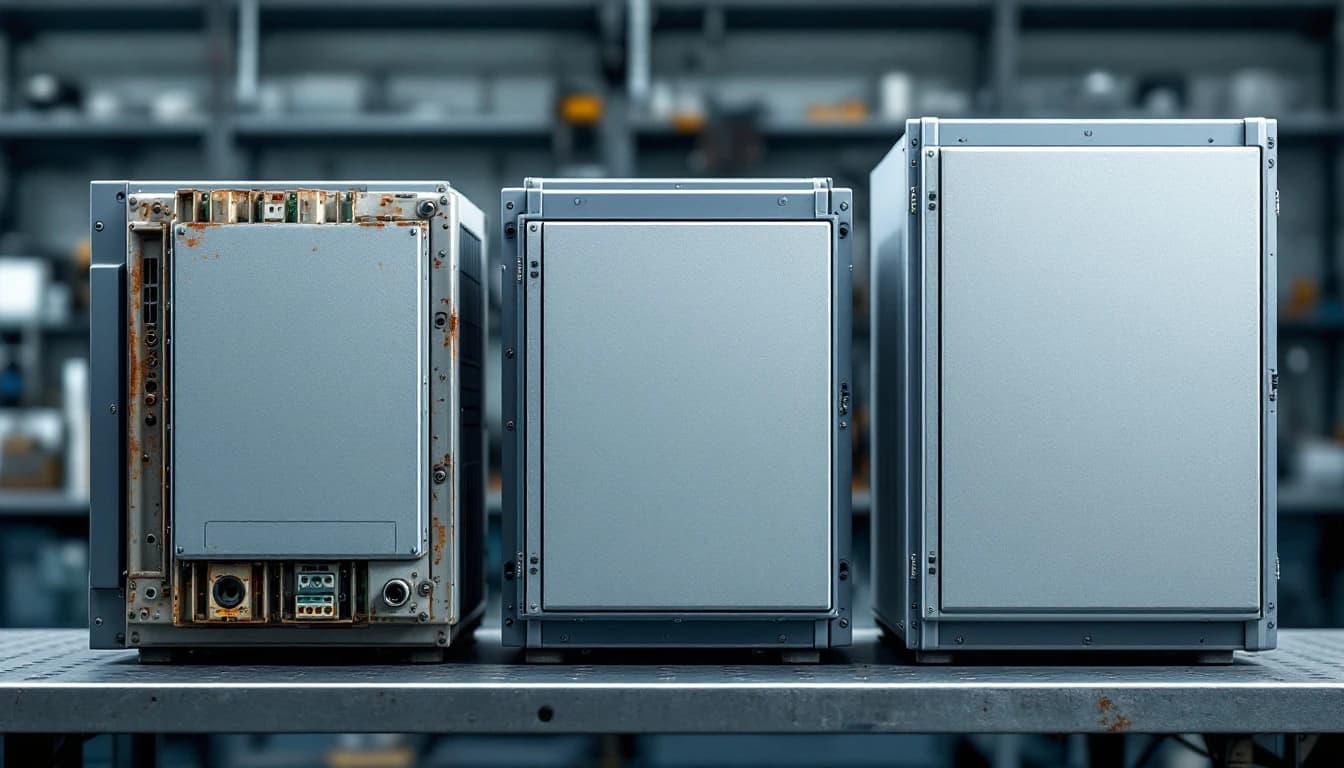
The MR-J2S Super series was Mitsubishi's workhorse servo amplifier for the early 2000s, and it's everywhere — Mazak-era CNC machines, packaging lines, general automation, tens of thousands of axes still in daily production. Mitsubishi moved on (J3, then J4, now J5); the installed base did not.
So when an MR-J2S-70A throws AL.32 and the axis is dead, you're choosing between three paths. As of August 2026 all three remain genuinely available, which is more than can be said for most control platforms of that generation, and the honest comparison between them is what this page is for.
First, what AL.32 actually is
AL.32 is an overcurrent fault, and on this family it overwhelmingly means one thing: the IPM — the intelligent power module — has failed. It's the classic MR-J2S death. (Before condemning the amp, rule out a shorted motor or cable with a megger test — a shorted motor will kill the replacement too. Our guide on isolating amplifier-vs-motor covers the 20-minute check, and it is not optional: connecting any of the three paths below to an un-meggered shorted motor buys you the same alarm twice.)
Other frequent J2S failures: control power supply (dead display), regeneration faults (AL.30), and encoder-interface issues (AL.16/AL.20 class) — all board-level.
Why the IPM is the recurring casualty is worth one paragraph, because it frames the whole decision. Power modules fail from thermal cycling: every acceleration heats the silicon, every dwell cools it, and two decades of that duty fatigues the module's internal joints — the wear-out mechanism the power-electronics reliability work published through IEEE has documented across exactly this component class. The DC bus electrolytics age in parallel, ripple grows, and the module runs harder than its 2003 design assumed. None of this is abuse. It is a twenty-year-old amplifier doing twenty-year-old-amplifier things, on the same schedule every other one of its siblings in the plant is on.
Path 1: Repair your amplifier
The IPM is a replaceable module, the parts supply for this family is deep, and the failure is bounded — which makes J2S repair one of the most predictable jobs on a servo bench. A proper repair means a new IPM (not a pull), gate-drive verification, control-supply check, full recap of aged electrolytics, and powered testing. The gate-drive step is the one that separates a repair from a part-swap: a degraded driver is frequently what killed the module, and it will kill the new one just as readily if nobody checks.
Typical cost: $450–$950 depending on size and collateral damage. Turnaround in days on the standard bench, faster on rush. Your parameters typically live in the amp's protected memory and survive; where a machine keeps them in the CNC, reinstall is plug-and-run anyway. (The general question of what survives a repair, platform by platform, has its own guide.)
This is the right answer when the machine is otherwise healthy and you want this axis back this week. The repair carries the same 24-month warranty as everything else on the servo drive bench, which is worth noticing in context: it is a longer promise than anyone will make you about a used unit of the same age.
Path 2: Buy a replacement J2S (exchange/used)
New-old-stock and used J2S amps are plentiful: roughly $235–$430 for the 400W–1kW sizes on the open market, more for big frames, more still from exchange programs with warranties. Two catches:
- Age. A used amp carries the same 20-year-old capacitors and a stranger's hours on its IPM. You may be buying the next AL.32.
- Compatibility details matter. Match the exact model and suffix (-A general purpose vs -B SSCNET, wattage, voltage class). A near-miss doesn't run.
A used unit makes sense as a shelf spare to pair with repairing your failed one — the repaired amp goes back in service, the spare covers the next event.
Path 3: Migrate the axis to MR-J4/J5
Mitsubishi's official renewal path is real and well-documented — conversion kits exist precisely because the installed base is huge. But be clear about scope: new amplifier, frequently a new motor or adapter engineering, wiring changes, parameter rebuild, and commissioning. Per axis, you're into four figures of hardware plus real engineering time — and on a multi-axis machine it's rarely sensible to migrate one axis alone.
The engineering time is the part that surprises people, so put a number on it: controls engineering runs well north of fifty dollars an hour fully loaded on Bureau of Labor Statistics figures before you touch a contractor rate, and a per-axis migration consumes days of it between design, wiring, parameters and proving. On a validated or safety-relevant machine, the modification also re-opens questions that the certification and functional-safety frameworks published through ISO and IEC answered at build time — which is change-control work, not soldering work, and it belongs in a planned project.
Migration is a planned capital project for a machine you're keeping for another decade. It is not a response to a Tuesday AL.32.
The three paths, side by side
| Repair yours | Used / exchange J2S | Migrate to J4/J5 | |
|---|---|---|---|
| Typical cost per axis | $450–$950 | $235–$430 used-market, more on exchange | Four figures of hardware plus engineering days |
| Time to running axis | Days | Days if the exact suffix is in stock | Weeks — it is a project |
| What you get back | Your amp with new wear items, 24-month warranty | Same-age hardware, unknown history | Current platform, restarted clock |
| Parameter handling | Preserved in protected memory | Transfer/re-enter, suffix must match exactly | Full rebuild and commissioning |
| Biggest risk | None unusual — bounded, predictable bench job | Buying someone else's countdown | Scope growth on a multi-axis machine |
| Right when… | Machine healthy, axis needed this week | You want a shelf spare alongside a repair | Rebuild or end-of-life planning is already funded |
The decision, honestly
- Axis down, machine otherwise good → repair ($450–$950, days). Free evaluation first; if the fault turns out to be your motor, you pay nothing and you've learned it safely.
- Running many J2S axes → repair failures as they occur and keep one known-good spare per frame size.
- Machine at end of life or mid-rebuild → fold servo migration into the rebuild, where its engineering cost belongs.
Two framing facts belong in that decision. First, downtime dominates: the Department of Energy has pushed condition-based maintenance for years on the strength of what unplanned stoppages actually cost, and against a down production axis the price gap between these paths is noise compared to the calendar gap. Second, the safety boundary: whichever path you choose, the cabinet work happens under lockout/tagout per OSHA and with the DC bus verified discharged — a servo bus holds lethal charge after power-off, and it does not care which repair strategy you picked.
The J2S platform has outlived its OEM support by design margin alone. Repair is how it keeps outliving it — and when yours throws its AL.32, start a repair with the alarm number and the model suffix, and it is usually back on the truck the same week. The rest of the Mitsubishi bench coverage is there when a different module on the same machine picks its own Tuesday.
Frequently asked questions
What does the AL.32 alarm mean on a Mitsubishi MR-J2S?
AL.32 is an overcurrent fault, and on this family it overwhelmingly indicates a failed intelligent power module — the classic J2S end-of-life event. Before condemning the amplifier, megger the motor and cable, because a shorted motor produces the same alarm and will destroy any replacement or repaired amplifier connected to it. With the motor cleared, the amplifier is a routine, bounded bench repair.
Is the MR-J2S still repairable even though it is obsolete?
Yes, and unusually well: the IPM is a replaceable module, the parts supply for this family remains deep, and the failure modes are well understood. A proper repair fits a new module (never a pull), verifies the gate drive that may have killed the old one, recaps the aged electrolytics and load-tests the result — returning an amplifier whose wear items are new, under a 24-month warranty.
How much does MR-J2S repair cost compared to a replacement?
As of August 2026, repair typically runs $450 to $950 depending on frame size and collateral damage, with a free evaluation first. Used J2S units run roughly $235 to $430 for the common 400W–1kW sizes on the open market — but carry the same twenty-year-old capacitors and an unknown IPM history. Exchange programs price higher for a warranty. Migration to J4/J5 is four figures of hardware per axis plus engineering days.
Will my servo parameters survive the repair?
Typically yes — J2S parameters live in the amplifier's protected memory, which is separate from the power and control circuitry the repair touches, and the parameter set is verified intact at final test. On machines where the CNC holds the axis parameters, the repaired amplifier reinstalls plug-and-run regardless. Back up what your machine allows before shipping anything; that habit costs minutes and covers every scenario.
What if several axes on the same machine are throwing J2S alarms?
Treat it as one investigation, not several coincidences. Shared causes come first: incoming power quality, a common regeneration resistor, cabinet heat that has aged every amplifier's capacitors on the same schedule, or a mechanical event that overloaded multiple axes at once. Meggering every motor while the cabinet is already open costs minutes rather than call-outs, gives you an insulation baseline for the axes that have not failed yet, and staggering the repairs — one axis at a time, with the shelf spare covering each in turn — keeps the machine producing through the whole campaign.
Should I buy a used J2S as a spare?
As a spare, yes — as the fix, think twice. The pattern that works on multi-axis plants is to repair the failed amplifier, return it to service with its new wear items, and shelf a used unit per frame size for the next event. Match the exact model and suffix when buying: -A general-purpose and -B SSCNET variants are not interchangeable, and a wattage or voltage near-miss simply will not run.
When does migrating to MR-J4 or J5 actually make sense?
When it is a funded project rather than a repair reaction: a machine you are committing to for another decade, ideally at rebuild time, migrating all axes together so the engineering, wiring and commissioning cost is spent once. Mitsubishi's renewal path and conversion kits are genuinely good. What they are not is a same-week answer to a single dead axis — that is what the repair path is for.
Have this exact problem?
Start a repair or get a free technician review — we'll tell you honestly whether it's worth fixing.