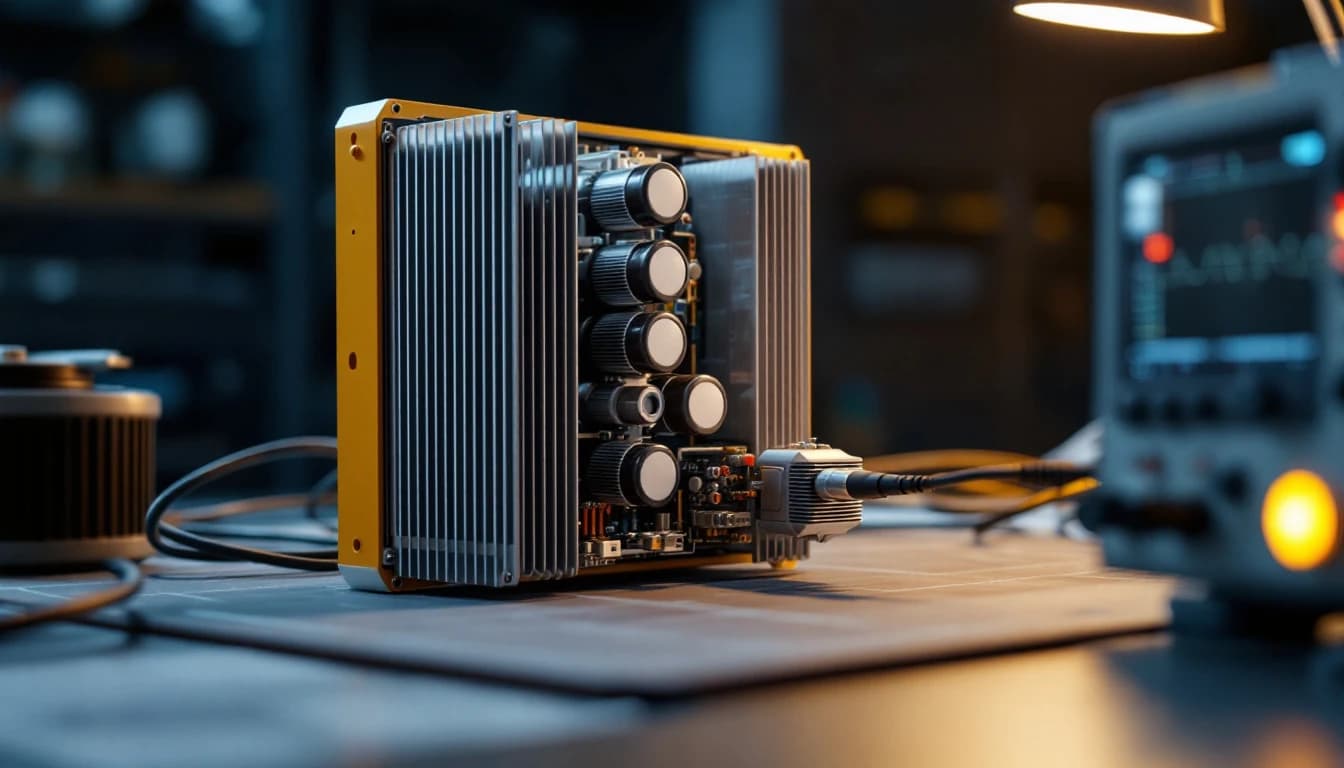
A FANUC spindle amplifier repair typically costs $750–$1,800 at our lab, quoted firm after a free bench evaluation. That range covers the alpha SPM (A06B-6078 and A06B-6088), alpha i SPM (A06B-6111) and beta i (A06B-6121) families. Standard turnaround is 3–5 business days in lab, rush service adds $149, and every completed repair carries a 24-month warranty. If the evaluation shows the amplifier is healthy and the fault lives in the motor or sensor, you pay nothing.
That is the short answer. The longer one is worth ten minutes, because a spindle amplifier is the most expensive single module in most machining-centre drive racks, it is the one that stops the machine outright, and a good share of the spindle alarms people ship amplifiers for are reported by the amplifier rather than caused by it.
The price table
As of October 2026 these are our documented repair ranges for the FANUC drive rack. Everything on a FANUC drive rack is quote-track rather than flat-price; the range is what these repairs have historically cost, and the firm number comes from the bench.
| Module | Typical catalog numbers | Typical repair | Turnaround in lab |
|---|---|---|---|
| Alpha spindle amplifier (SPM) | A06B-6078, A06B-6088 | $750–$1,800 | 3–5 business days |
| Alpha i spindle amplifier (SPM) | A06B-6111 | $750–$1,800 | 3–5 business days |
| Beta i spindle amplifier | A06B-6121 | $750–$1,800 | 3–5 business days |
| Power supply module (PSM) | A06B-6077, A06B-6087, A06B-6110, A06B-6120 | $500–$1,200 | 3–5 business days |
| Servo amplifier (SVM) on the same rack | A06B-6079, A06B-6096, A06B-6114, A06B-6130 | $650–$1,500 | 3–5 business days |
| Control / interface PCB | A16B, A20B series | $300–$800 | 3–5 business days |
| Rush service | Any accepted module | +$149 | 1–2 business days |
| Emergency bench attempt | Capacity confirmed first | +$399 | Same / next business day |
Three honest notes on reading it. The evaluation is free and no work proceeds without your written approval of the quote. "Typical" describes the bulk of real jobs, not a ceiling — a module that took a phase event through the input stage, the bus and the gate drivers at once can quote above the band, and you see that number before you decide anything. And spindle amplifiers are heavy: units over 50 lb ship by freight rather than parcel, so contact us before you order if you are sending one of the large frames.
Why the spindle amplifier costs more than the axis amplifiers
On the same rack, our servo amplifier repairs typically run $650–$1,500 and the spindle amplifier $750–$1,800. The difference is not a brand premium. It is physics.
A spindle amplifier is sized for the spindle motor's continuous and thirty-minute ratings, which on a machining centre are routinely several times the rating of any single feed axis. That means larger power semiconductors, a heavier DC link section, bigger current sensors and a heat sink that takes up most of the module. When the power stage fails, the parts that have to be replaced are the largest and most expensive parts on the rack.
It is also the hardest-working module thermally. A feed axis spends most of its life holding position or moving at modest load. A spindle accelerates a heavy rotating mass to speed, holds cutting load for minutes at a time, then decelerates that same mass — and on a FANUC alpha system with a regenerative power supply module, that deceleration energy goes back through the shared DC link. Every tool change is a full thermal cycle for the output stage.
Adjustable-speed drive systems of this kind are standardised under the IEC 61800 series (iec.ch), which is one reason the failure modes rhyme across manufacturers even when the part numbers do not.
What moves the quote inside the range
Four variables, in rough order of weight.
- Whether the power stage failed. A replaced IGBT or intelligent power module is the top of the band. A control power supply, a gate-drive component, a current sensor or a cooling fan is the bottom of it. The alarm number usually tells us which before the box is opened — AL-12 and a blown DC link fuse point at the power stage; a fan alarm does not.
- Module rating. The larger alpha and alpha i frames use more and larger power devices. More silicon to replace means a higher number.
- Collateral damage. An amplifier that failed because a motor winding or power cable shorted to ground often lost its gate drivers and current detection along with the output stage. It is one repair, but it prices at the top of the range.
- Age of the family. The alpha generation (6078 and 6088) is long out of production. Parts are still obtainable, but some need sourcing rather than pulling from a drawer.
What does not move the quote: reprogramming. On FANUC systems the spindle parameters live in the CNC, not in the amplifier, so a repaired module goes back into the rack and runs on the parameters already there in nearly every case.
"People budget the spindle drive like it is an axis amp with a different sticker. It is not. It is the biggest power stage in the cabinet and it gets cycled hard on every tool change. When it lets go it usually takes something with it, and that is what you are paying for."
— CNC service technician, 24 years, job-shop and aerospace machining; name withheld by request
The alarms that actually mean the amplifier
The spindle amplifier displays its own two-digit alarm on the module, separate from whatever the CNC screen shows. That number is the single most useful thing you can send with the unit, and it sorts fairly cleanly into "amplifier", "not the amplifier" and "the power supply module is reporting through me".
Usually the amplifier itself:
- AL-12 — overcurrent in the DC link or the power module's own protection operated. The classic failed output stage, provided the motor and cable test clean.
- AL-03 — DC link fuse blown inside the module. The fuse is the evidence; the shorted device behind it is the cause.
- AL-09 — main circuit overheat. Often a dead fan or a packed heat sink before it is a failed sensor.
- AL-19 / AL-20 — excessive offset in the phase current detection circuits. An internal fault by definition.
- AL-56 — internal cooling fan stopped. Cheap if caught, expensive if ignored.
Usually not the amplifier:
- AL-01 — motor overheat. The motor thermostat or its wiring, a blocked motor fan, or a genuinely overloaded spindle.
- AL-02 — excessive speed deviation. The spindle is not following its command: a mechanical load problem, a failing bearing, a slipping belt — or, less often, an amplifier that is not delivering torque.
- AL-27, AL-31, AL-73 — position coder, speed detector or motor sensor signal faults. Sensor, cable or connector far more often than the module.
Reported by the spindle amplifier on behalf of the power supply module:
- AL-04 (input open phase), AL-30 (overcurrent in the PSM main circuit), AL-33 (DC link precharge failure), AL-51 (DC link undervoltage), AL-58 and AL-59 (PSM overload and PSM cooling fan).
That last group is the one that costs people money. The spindle amplifier is displaying it, so the spindle amplifier gets pulled and shipped, and the real fault is one module to the left. Confirm the exact meaning against the maintenance manual for your amplifier series, because alarm tables differ slightly between the alpha and alpha i generations — but as a rule, if the spindle alarm is in the thirties or fifties, look at the power supply module first. We cover that module in detail in FANUC PSM alarm codes.
Before you pull it: three checks that are free
Megger the motor and cable, disconnected from the amplifier. An insulation fault to ground in the spindle motor or its power cable will destroy a freshly repaired output stage on the first acceleration. This is the single most valuable test in the whole exercise, and it must be done with the leads off the amplifier terminals so the test voltage never reaches the drive.
Check incoming power, phase to phase, under load. The U.S. Department of Energy's motor-systems guidance (energy.gov) notes that current unbalance in a three-phase motor circuit typically runs 6 to 10 times the percentage voltage unbalance. A plant bus that is only slightly lopsided on a meter can be pushing one phase of the rectifier and DC link much harder than the others — and the spindle, being the biggest load, is where it shows.
Look at the fans and the heat sink. A spindle amplifier breathing through a mat of coolant mist and fines is running hot whether or not it has alarmed yet. The standard rule of thumb for electrolytic capacitors is that every 10 °C of sustained temperature rise roughly halves their service life, so a clogged heat sink is quietly spending the bus capacitors.
None of this needs the cabinet live. Drive DC link capacitors hold a lethal charge after the disconnect is opened; the product safety standard for these drives requires a warning label wherever the stored charge takes longer than 5 seconds to fall below 60 V, and FANUC's label tells you how long to wait. Follow it, then verify with a meter. OSHA's control-of-hazardous-energy rules (osha.gov) are estimated by the agency to prevent around 120 fatalities and 50,000 injuries a year, and NFPA 70E (nfpa.org) sets the arc-flash boundary at the distance where incident energy falls to 1.2 cal/cm² — the onset of a second-degree burn. Those numbers exist because cabinets like this one have hurt people who trusted a dark indicator.
Repair against the real alternatives
Nobody is actually choosing between a repair and a brand-new amplifier at list price. The real choices are these.
OEM exchange. Where the family is still supported, exchange is the fastest route and the most expensive one. For the discontinued alpha generation it may not be offered at all. You also receive a different serial number, which matters in some quality systems.
Used or surplus. A used spindle amplifier of the same age carries the same aged bus capacitors and the same hours on its power stage, usually with a warranty measured in weeks. It is a sensible bridge when the machine has to run tonight — and the smartest way to use it is to fit the surplus unit, send yours for repair, and keep the repaired original as the tested spare.
Retrofit. Moving to a current drive generation means new amplifiers, usually new motors or adapter engineering, parameter work and commissioning. That is the right answer for a machine that is near the end of its life anyway. For a mechanically sound machining centre it is a capital project, and the arithmetic is worked through in repair vs. replace: the actual math.
Against all three, the number that dominates is downtime, not the invoice. NIST research on manufacturing maintenance (nist.gov) put U.S. machinery maintenance spending at roughly $50 billion a year in its industry study, and unplanned failures are the costly end of that figure. A machining centre without a spindle produces nothing at all, which is the whole case for rush service on this particular module.
Federal price data makes the background argument: the producer price series for machinery and equipment (bls.gov) has run ahead of the general index for several years, so the replacement-cost side of the comparison keeps moving in one direction.
What we will and will not do
We replace failed IGBT and power-stage devices, repair gate-drive, DC link and control-supply circuits, replace fans and verify the thermal path, and recap the module as standard practice rather than replacing only the part that failed. Every repair carries the 24-month warranty.
We do not repair spindle motors, magnetic sensors or position coders — if evaluation shows the fault is on the motor side, we tell you that and the evaluation costs you nothing. And if a module's damage exceeds its economic value, you hear that at the quote, not after.
If you are not yet sure which module on the rack is guilty, the A06B part-number guide tells you what you are holding, and FANUC alarm 401, 410 and 411 covers the axis side of the same cabinet. For the broader price picture across brands see servo amplifier repair cost. When you are ready, request a quote with the alarm number and the machine make and model, and pack the module using our mail-in instructions — a spindle amplifier is heavy enough to destroy itself in a thin box.
Frequently asked questions
How much does it cost to repair a FANUC spindle amplifier?
Typical FANUC spindle amplifier repairs run $750–$1,800, quoted firm after a free bench evaluation. The low end is a control-supply, fan or gate-drive repair; the high end is a full power-stage replacement on a large module with collateral damage. No work starts without your written approval of the quote.
Why does a spindle amplifier cost more to repair than a servo amplifier?
Because it is the largest power stage on the rack. The spindle amplifier is sized for the spindle motor, which is usually several times the rating of any feed axis, so its power devices, DC link components and current sensors are bigger and cost more to replace. It is also thermally cycled on every tool change, so failures tend to involve more than one component.
My machine shows a spindle alarm only under load. Is that the amplifier?
Often, yes. Load-dependent trips are commonly a weakening power stage or aged bus capacitors inside the amplifier, both of which are repairable. Megger the motor and cable first with the leads off the amplifier; if those test clean, send the module with the alarm number. If evaluation shows the amplifier is healthy, you pay nothing.
Which FANUC spindle alarms point to the power supply module instead?
Alarms 04, 30, 33, 51, 58 and 59 on the spindle amplifier are, as a rule, the amplifier reporting a power supply module condition — open phase, PSM overcurrent, precharge failure, DC link undervoltage, PSM overload and PSM fan. Check the power supply module and incoming power before pulling the spindle amplifier, and confirm against the maintenance manual for your series.
Do I need to reload spindle parameters after the repair?
In nearly all cases, no. On FANUC systems the spindle parameters are stored in the CNC rather than in the amplifier, so the repaired module reinstalls and runs on the existing parameters. Keep a current parameter backup regardless — that is good practice independent of any repair.
How long does a spindle amplifier repair take?
Standard turnaround is 3–5 business days in lab once the module arrives, plus shipping each way. Rush service is $149 and brings that to 1–2 business days in lab. Emergency service is $399 for a same or next business day bench attempt, and you should contact us first so we can confirm bench availability.
What if the amplifier cannot be repaired?
Then nothing has been charged. Spindle amplifiers are quote-track: the evaluation is free and work never proceeds past an approved quote, so an unrepairable module costs you return shipping and nothing else. You also leave with a straight verdict from a bench, which is worth having before you spend money on an exchange unit.
Have this exact problem?
Start a repair or get a free technician review — we'll tell you honestly whether it's worth fixing.