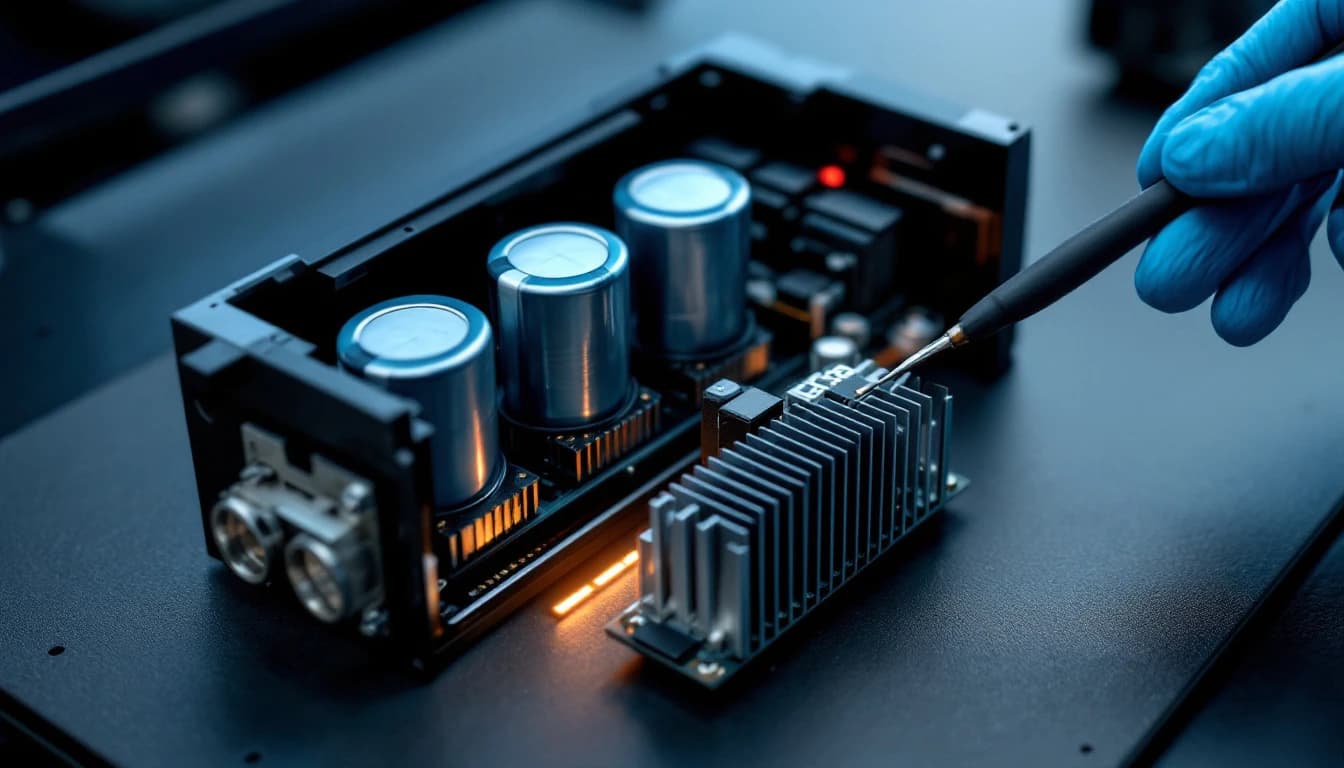
On an ABB ACS-series drive, fault 1 (OVERCURRENT) means the output stage saw current beyond its trip threshold, fault 2 (DC OVERVOLT) means the DC bus climbed above limit — usually a decelerating load pushing energy back with nowhere to send it — and fault 6 (DC UNDERVOLT) means the bus collapsed, from a supply problem or from aged bus capacitors that can no longer hold charge. All three are diagnosable in under an hour on the machine, and all three are board-level repairable when the fault is in the drive rather than the motor or the plant supply.
This guide is written for the person standing at the cabinet with the fault on the keypad. It covers what the code actually indicates, how to separate a drive fault from a motor or supply fault before you ship anything, and where the honest boundary of repair sits.
The fault table
As of September 2026, these are the ACS faults that dominate the drives arriving at our bench, with what they mean and what they normally cost to fix. We service ABB ACS150, ACS355, ACS550 and ACH550 drives up to 25 HP; free evaluation, typical repairs $300–$900.
| Code | Keypad text | What it actually indicates | Usual root cause | Repairable at board level? |
|---|---|---|---|---|
| 1 | OVERCURRENT | Output current exceeded the trip threshold | Failed IGBT or gate driver; shorted motor or cable; too-fast acceleration ramp | Yes, when the fault is in the drive |
| 2 | DC OVERVOLT | DC bus voltage above limit | Regenerating load with no brake path; failed brake chopper or resistor; high line voltage | Yes |
| 3 | DEV OVERTEMP | Heatsink over temperature | Failed or clogged cooling fan; blocked airflow; dried thermal interface | Yes — one of the cheapest fixes |
| 4 | SHORT CIRC | Short detected at the output | Shorted IGBT module; shorted motor winding or cable | Yes, when the short is inside the drive |
| 6 | DC UNDERVOLT | DC bus voltage below limit | Aged bus capacitors; failed precharge circuit; genuine supply sag or phase loss | Yes |
| 16 | EARTH FAULT | Current imbalance to ground | Motor insulation breakdown; damaged cable; failed output stage | Sometimes — often a motor-side finding |
| 22 | SUPPLY PHASE | Input phase loss or severe imbalance | Blown input fuse; failed rectifier leg; utility or upstream problem | Yes, when a rectifier leg has failed |
ABB's newer generation replaced these numeric codes with IEC-style four-digit identifiers — 2310 overcurrent, 2340 short circuit, 3130 input phase loss, 4210 IGBT over temperature and the 3210/3220 DC-link pair — but the underlying physics and the bench work are identical. If your keypad shows a four-digit code, read the row above that matches the description rather than the number.
Fault 1 — OVERCURRENT
Overcurrent is the most common code on this platform and the most commonly misread. The drive is telling you it measured current above threshold; it is not telling you where the current went.
Rank the causes in this order. First, the load and the ramp: an acceleration time set too aggressively for the inertia, or a mechanically jammed load, produces a genuine overcurrent from a perfectly healthy drive. If the fault only appears on start, or only appeared after somebody changed a parameter, start there.
Second, the motor and cable. Disconnect all three output leads at the drive terminals and megger the motor and cable to ground and phase-to-phase. A shorted winding or a nicked cable in a wet conduit will trip an overcurrent every time, and no drive repair fixes it. This test costs ten minutes and is the single highest-value thing you can do before shipping.
Third, the drive itself. With the motor disconnected, if the drive still trips overcurrent the instant it is enabled, the output stage is the suspect: a failed IGBT module, a failed gate driver, or damaged current-sense circuitry. That is bench work and it is repairable.
The same logic applies across manufacturers — the PowerFlex fault-code guide walks the equivalent F012 hardware overcurrent on Allen-Bradley drives, and the diagnostic sequence is the same one.
Fault 2 — DC OVERVOLT
A DC bus overvoltage almost always means energy is arriving that has nowhere to go. A decelerating high-inertia load — a fan wheel, a centrifuge, a loaded conveyor coming down a grade — turns the motor into a generator and pumps that energy back into the bus. If the deceleration ramp is shorter than the load's natural coast, or if the drive has no dynamic braking path, the bus climbs until the drive protects itself.
Check three things, in order. The ramp: lengthening deceleration time is free and frequently solves it outright. The brake circuit: if the machine has a braking resistor, verify it is actually connected and measure it — an open resistor or a failed chopper transistor is a common and repairable drive-side fault. The line: measure incoming voltage under load. A supply running persistently high leaves less headroom for any regeneration at all.
"Overvoltage is the fault people blame the drive for the least often and should blame it for the most often. Half the time it's a brake resistor that's been open for two years and nobody noticed until the load got heavier."
— Drive commissioning technician, 14 years, water and wastewater; name withheld by request
Fault 6 — DC UNDERVOLT
Undervoltage splits cleanly into two very different stories, and telling them apart is the whole job.
The plant story. A genuine sag, a dropped phase, a loose lug, or an upstream event will pull the bus down. Undervoltage faults that hit several drives at once, or that correlate with a large motor starting elsewhere in the plant, are a distribution problem — not something a bench can fix. Check for fault 22 alongside it; the pair together usually means input side.
The drive story. A single drive that trips undervoltage while its neighbours run happily is telling you about itself. The usual cause is bus capacitor aging. Those are wet electrolytic components sealed behind a rubber bung, and electrolyte escapes through that seal over years of heat: capacitance falls, equivalent series resistance climbs, and the bank can no longer hold the rail through a normal load step. The manufacturers' own Arrhenius guidance is the shortcut worth carrying — every 10 °C of sustained temperature rise roughly halves electrolytic life, which is why the drive in the hot corner of the cabinet always fails first.
The second drive-side cause is the precharge circuit: the resistor and contactor or thyristor arrangement that limits inrush while the bus charges. When precharge fails, the bus never reaches full voltage in the first place. Both failures are standard board-level repairs.
What to check before you ship anything
Fifteen minutes here regularly prevents a shipping cycle:
- Record the fault code and the fault history. ACS drives log recent faults; the sequence tells a far better story than the current code alone.
- Note what the machine was doing. On start, at speed, on deceleration, or at random — this single observation separates most overcurrent, overvoltage and undervoltage causes.
- Megger the motor and cable with the output leads disconnected at the drive. Rule the motor in or out before you rule the drive in.
- Measure incoming voltage on all three phases, under load if you safely can.
- Look at the fans and the heatsink. A clogged heatsink or a fan that does not spin explains an overtemperature fault and contributes to every other one.
- Check the drive's HP and voltage rating against our coverage — we service ACS drives up to 25 HP and decline larger frames honestly rather than under-test them.
Everything above happens with the drive de-energized and locked out, and with respect for the DC bus: those capacitors hold a lethal charge after the main is open. Wait the manufacturer's stated discharge time and verify with a meter before touching a terminal.
What repair costs and what you get
ABB ACS drives up to 25 HP are evaluated free and quoted firm, typically $300–$900. A repair covers IGBT, rectifier and bus-capacitor replacement, precharge and control-circuit repair, and a powered test with a motor load appropriate to the frame — not a bench power-up and a shrug. Every completed repair carries the 24-month warranty. Standard turnaround is 3–5 business days in lab, rush service is $149 for 1–2 days, and an emergency bench attempt is $399 by prior arrangement.
Against a four-figure replacement drive with a procurement cycle attached, that math is rarely close — and the full comparison sits in VFD repair cost alongside the other manufacturers. The VFD repair page lists platform coverage, and the brands page covers the rest of the ABB range we see.
Context worth having on file
- The U.S. Department of Energy has long documented that motor-driven systems consume roughly half of all industrial electricity — which is why a failed drive is rarely just a failed drive, and why speed control is the highest-leverage efficiency measure in most plants.
- IEC 61800 is the adjustable-speed electrical power drive systems standard family, including the 61800-5-1 safety requirements that govern how these products are built and the 61800-3 EMC requirements that explain a surprising number of nuisance trips.
- NFPA 70B became a full standard in 2023, pushing plants toward documented condition-based maintenance — thermal imaging of drive cabinets is exactly the kind of practice it contemplates.
- OSHA estimates proper control of hazardous energy prevents roughly 120 fatalities and 50,000 injuries annually. A drive's DC bus is the textbook case of stored energy that survives lockout.
- NIST SP 800-82 covers industrial control system security, and CISA publishes the advisories that identify known vulnerabilities in installed drive and controller hardware — relevant whenever a networked drive leaves your site.
- The IEEE 493 lineage remains the standard published source for industrial equipment failure-rate data when a capital request needs a defensible number.
Shipping the drive
Start at start-a-repair for an RMA number and the Arlington lab address. Send the drive only — no motor, no cable — with the fault code, the HP and voltage rating, and a note on what the machine was doing when it tripped. That last detail changes the bench sequence more than anything else you can write on the form. Pack it properly; the packing guide takes ten minutes and prevents the most avoidable failure mode in this whole process, which is a repairable drive arriving broken.
Frequently asked questions
What does ABB fault 1 OVERCURRENT mean?
It means the drive measured output current above its trip threshold. The three causes, in order of likelihood, are a load or ramp problem, a shorted motor or cable, and a failed output stage inside the drive. Disconnect the motor leads and megger the motor and cable first — if the drive still trips overcurrent the moment it is enabled with nothing connected, the fault is in the drive and it is repairable.
What causes an ABB DC OVERVOLT fault 2?
Energy arriving at the DC bus faster than it can be used or dissipated — nearly always a decelerating high-inertia load regenerating into the bus. Check the deceleration ramp first, then the braking resistor and chopper circuit (an open resistor or failed chopper transistor is a common drive-side fault), then the incoming line voltage.
Is a DC UNDERVOLT fault 6 the drive or the plant supply?
Both are common, and the pattern tells you which. If several drives fault together, or the fault tracks a large motor starting elsewhere, it is a supply problem. If one drive faults while its neighbours run fine, it is usually that drive — aged DC bus capacitors that can no longer hold the rail, or a failed precharge circuit. Both are standard board-level repairs.
Can you repair a drive with a failed IGBT?
Yes — IGBT module replacement is core bench work, along with the gate drivers and current-sense circuitry that often fail with them. The important step is confirming the motor and cable are healthy first, because a shorted winding will destroy a freshly repaired output stage within seconds of the first run.
How much does ABB ACS drive repair cost?
ABB ACS150, ACS355, ACS550 and ACH550 drives up to 25 HP are evaluated free and quoted firm, typically $300–$900, including IGBT, rectifier and bus-capacitor work, a powered load test, and a 24-month warranty. Rush service is $149 and emergency bench attempts are $399.
My drive shows a four-digit code, not a number from your table. Does that change anything?
No. The newer ABB generation uses IEC-style four-digit fault identifiers instead of the simple numeric codes, but the physical faults and the bench work are the same. Match on the description shown on the keypad rather than the number, and send us both — the code and the text — with the drive.
How long does VFD repair take?
Standard turnaround is 3–5 business days in lab once the drive arrives, plus freight each way. Rush service is $149 for 1–2 business days. Emergency service is $399 for a same or next business day bench attempt, arranged by phone or email first so we can confirm bench availability.
Have this exact problem?
Start a repair or get a free technician review — we'll tell you honestly whether it's worth fixing.