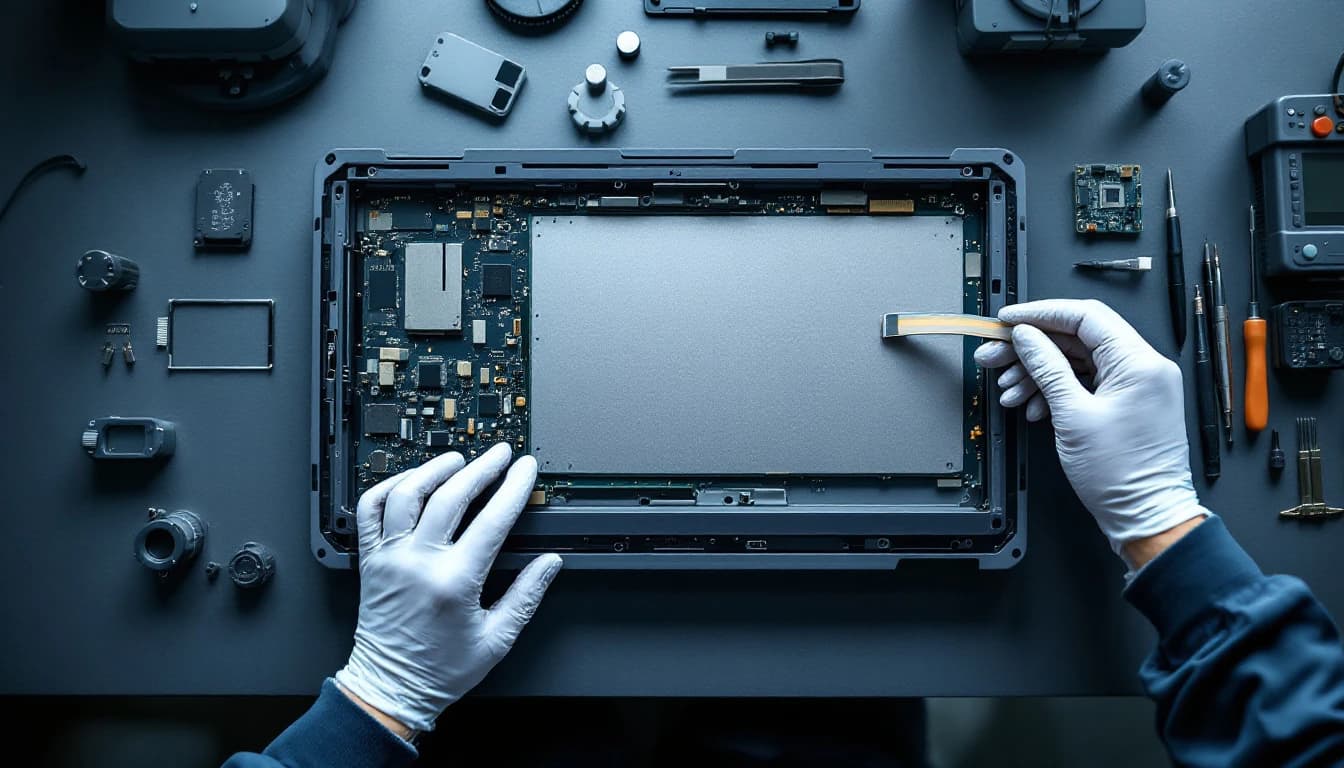
Allen-Bradley PanelView repair is a flat $499 for PanelView Plus 6 terminals in the 400–1000 sizes, $649 for PVP6 1250/1500 and for PanelView Plus 7 in 7–10 inch sizes, $749 for 12 and 15 inch PVP7, $399 for PanelView 800, and from $449 for the legacy PanelView Standard family. Parts, testing and a 24-month warranty are included, and your application stays on the terminal.
That is the whole answer. The rest of this guide is the reasoning behind those numbers, the four variables that change the total cost of the incident, and the specific reason repair has become the default answer on most of this product line rather than a budget compromise.
The price table
As of September 2026 these are our published flat prices for the PanelView range. Every figure was re-verified against the live catalogue this month.
| Terminal family | Typical catalog numbers | Repair price | Turnaround |
|---|---|---|---|
| PanelView Plus 6 — 400, 600, 700, 1000 (4"–10") | 2711P- series | $499 flat | 3–5 business days |
| PanelView Plus 6 — 1250 & 1500 (12.1" / 15") | 2711P- large format | $649 flat | 3–5 business days |
| PanelView Plus 7 Standard & Performance — 7", 9", 10" | 2711P-T7C, -T9C, -T10C | $649 flat | 3–5 business days |
| PanelView Plus 7 — 12" & 15" | 2711P-T12C, -T15C | $749 flat | 3–5 business days |
| PanelView 800 — 4", 7", 10" | 2711R-T4T, -T7T, -T10T | $399 flat | 3–5 business days |
| PanelView Standard — 300 to 1400 | 2711-T10C8 and siblings | from $449 | 3–5 business days |
| Rush service (any of the above) | — | +$149 | 1–2 business days |
| Emergency bench attempt | — | +$399 | Same / next business day |
The flat price covers evaluation, board-level repair of the standard failure modes, replacement parts, full functional testing and the 24-month warranty. If a flat-price terminal turns out to be unrepairable, the repair price is refunded in full less return shipping.
PanelView Standard is priced "from" rather than flat for an honest reason: that family spans two decades of vintages with parts that vary considerably, so the firm number is confirmed after a free evaluation and never proceeds without your approval.
Why the PVP7 number is the interesting one
The line in the table that surprises people is PanelView Plus 7 at $649. These are current terminals, not obsolete ones — and factory-channel repair on them is quoted in the $2,700–$4,000 range, which approaches the cost of a replacement terminal and is presumably meant to.
The dominant PVP7 failure is the bonded touch assembly: the glass, digitizer and display are laminated as a unit, so a touch failure that would have been a $40 part on a 1990s terminal becomes an assembly-level job. It is a genuinely harder repair than the older generations. It is not a $3,000 repair.
For the discontinued generations the calculus is different again, and simpler. Rockwell ended the PanelView Plus 6 line in 2021 with no direct drop-in replacement, which is covered in PanelView Plus 6 discontinued — what now?. When there is no like-for-like part to buy, "just replace it" stops being a purchasing decision and becomes a migration project.
What actually fails
Flat pricing works on HMI terminals because the failure set is bounded and repeats. Three modes dominate across every PanelView generation:
Power supply failure. A terminal that is dead, boot-loops, or powers up and shuts down almost always traces to aged electrolytic capacitors in the 24 VDC input stage. This is the same chemistry that takes out drives and rack supplies in the same cabinet — every 10 °C of sustained temperature rise roughly halves electrolytic life, so a terminal mounted on a warm enclosure door above a drive stack ages on an accelerated schedule.
Touch failure. Dead zones, drift, or a screen that renders perfectly while ignoring every press. On older resistive terminals that is a worn digitizer; on PVP7 it is the bonded assembly. Either way the logic board is usually healthy, and if the terminal still answers over the network while the glass does not, you have already proved it.
Backlight failure. A dark screen that still shows faint graphics under an angled flashlight is a backlight, not a dead terminal. That sixty-second test is worth doing before you ship anything and is described in the flashlight test.
"We had a PanelView Plus 7 quoted at just under three thousand through the normal channel, on a machine that was otherwise perfect. Nobody in the building could explain to me what made that screen worth three thousand dollars. That quote is what sent me looking for a board-level shop in the first place."
— Plant engineer, 14 years, food and beverage; name withheld by request
What changes the total
Flat means flat for the listed failure modes. Four variables still move the total cost of the incident:
- Screen size. Bigger displays carry larger LCD and touch assemblies, which is the entire reason the 12 and 15 inch tiers sit above the 7 to 10 inch tiers in both PVP6 and PVP7.
- Speed. Rush at $149 and emergency at $399 exist because unplanned downtime dwarfs both. ABB's Value of Reliability survey of 3,215 plant respondents put average unplanned downtime at $125,000 per hour globally; against a number like that the repair price is rounding error and the calendar is everything.
- Collateral damage. A terminal that took a surge, a miswired supply or a forklift can carry damage beyond the standard set. That is what the evaluation finds, and you hear about it before anything additional is charged.
- Shipping and packing. You pay freight in; return shipping is quoted with the repair. A repairable terminal that arrives with a cracked LCD because it travelled in a thin box has converted a flat repair into a quote — ten minutes with the packing guide prevents that.
What does not change the price: your application. The runtime project lives in the terminal's internal flash and its removable card, physically separate from every component in the standard failure set. Repaired terminals are tested booted into your screens, and the reasoning is set out in does my program survive the repair?
Repair against replacement in 2026
Work the comparison honestly and it splits by generation.
PanelView Plus 6 and PanelView Standard. There is no like-for-like replacement to buy. Replacement means a current-generation terminal, a project conversion, panel-cutout work and re-commissioning — weeks and engineering hours against a flat repair measured in days. New-old-stock large-format PVP6 terminals, when they surface at all, are quoted well above the repair price.
PanelView Plus 7. A direct replacement does exist, at a list price that makes a $649 flat repair straightforward arithmetic even before you count the commissioning time.
PanelView 800. The margin is narrower here because the terminals are inexpensive, and we will say so. The case for repair on an 800 is usually lead time and the fact that the configured terminal comes back rather than an empty one.
There is a systems-level point underneath all of this. The economic life of industrial control hardware is now routinely longer than its commercial availability, which is why asset-management practice (iso.org) and the standards bodies that define industrial machinery electrical practice (nfpa.org, iec.ch) all treat serviceability as a design property rather than an afterthought. A terminal that can be repaired to component level is an asset with a longer runway than its catalogue status suggests.
Before you pull the terminal
Open the disconnect and verify dead before you touch the back of the enclosure — the control-of-hazardous-energy rules (osha.gov) exist because cabinets that look dead frequently are not. Then, before power-down, photograph the screen and note exactly what it does: dark but backlit, faint under a flashlight, boot-looping, touch dead in one region or everywhere. Those four observations shorten the bench evaluation more than anything else you can send us.
Ship the terminal only — no enclosure doors, no mounting hardware, no PLC. The mail-in instructions cover the rest, and if the rack behind the terminal is also dark you may be chasing the wrong box entirely: start with the PLC rack power supply and the broader PLC repair costs.
Manufacturing statistics make the background point plainly enough: producer prices for machinery and equipment (bls.gov) have outrun the general index for years, while research funding for advanced manufacturing productivity (nist.gov) keeps making the case that uptime, not capital spend, is where plants actually win. Keeping a working terminal working is the cheapest form of that.
Frequently asked questions
How much does PanelView repair cost?
A flat $499 for PanelView Plus 6 in the 400 to 1000 sizes, $649 for PVP6 1250/1500 and PanelView Plus 7 at 7 to 10 inches, $749 for 12 and 15 inch PVP7, $399 for PanelView 800, and from $449 for legacy PanelView Standard terminals. Parts, testing and a 24-month warranty are included.
Why is factory repair on a PanelView Plus 7 so much more expensive?
Factory-channel PVP7 repair is commonly quoted between $2,700 and $4,000, which sits close enough to a replacement terminal that it functions as a nudge toward buying new. The underlying repair — most often the bonded touch and display assembly — is genuinely more involved than on older terminals, but not by that multiple.
Will my application survive the repair?
Yes. The runtime project is stored in the terminal's internal flash and removable memory card, which are physically separate from the power supply, touch digitizer and backlight components that actually fail. Repaired terminals are tested booted into your application, and nothing is reset unless a repair strictly requires it — in which case you are told first.
My PanelView Plus 6 is discontinued. Is repair really the best option?
In most cases yes, because Rockwell ended the PVP6 line in 2021 with no direct drop-in replacement. Replacing means a current-generation terminal plus project conversion, panel work and re-commissioning. A flat repair returns the exact configured terminal in days.
The screen is dark but I can hear it running. Is that repairable?
Almost certainly, and cheaply. A dark screen that shows faint graphics when you shine a flashlight across it at an angle is a backlight failure, not a dead terminal, and it is covered by the flat price. Check that before assuming the worst.
How long does a PanelView repair take?
Standard turnaround is 3–5 business days in lab once the terminal arrives, plus shipping each way. Rush service is $149 for 1–2 business days. Emergency service is $399 for a same or next business day bench attempt — contact us before purchasing it so we can confirm bench availability.
What if you cannot repair my terminal?
On the flat-price families the repair price is refunded in full, less return shipping. Unrepairable terminals are rarer than expected, because the dominant failures are power supply capacitors, touch digitizers and backlights, all of which are standard board-level work.
Have this exact problem?
Start a repair or get a free technician review — we'll tell you honestly whether it's worth fixing.