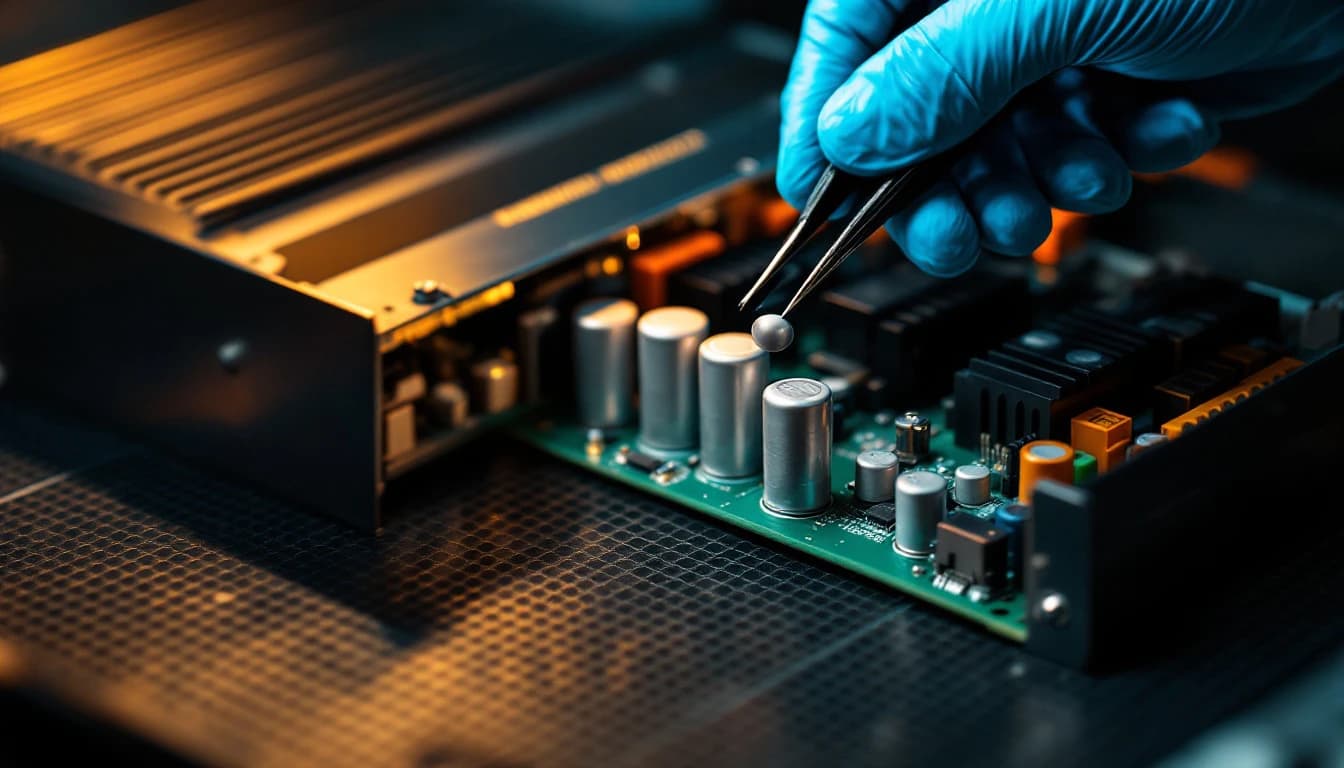
Repairing an industrial power supply costs a flat $349 at our lab for PLC rack supplies — Allen-Bradley SLC 500 and ControlLogix, Siemens PS307 and PS407 and equivalents — with parts, a full load test, and a 24-month warranty included. Drive-side supplies are quoted after a free evaluation, typically $500–$1,200 for a FANUC power supply module. Standard turnaround is 3–5 business days in lab; rush is $149.
That is the number most maintenance people want inside the first ten seconds, usually while standing in front of a rack that went dark on second shift. The rest of this guide explains where those figures come from, which four variables actually move them, and why the power supply is the single most repair-friendly component in an industrial control cabinet.
The price table
As of September 2026, our published pricing for industrial power supply work:
| Unit type | Typical catalog numbers | Price | Turnaround |
|---|---|---|---|
| PLC rack power supply | 1746-P1/P2/P4, 1756-PA72/PB72/PA75, 6ES7 307-1EA01, 6ES7 407-0KA02 | $349 flat | 3–5 business days |
| FANUC power supply module (PSM) | A06B-6077, A06B-6087, A06B-6110 | Free evaluation, typically $500–$1,200 | 3–5 business days |
| FANUC control power PCB | A16B-1210-0480, A16B-1212-0110 | Free evaluation, typically $300–$800 | 3–5 business days |
| Inverter-generator inverter unit | Honda EU-class and similar | from $549 | 3–5 business days |
| Rush service (any of the above) | — | +$149 | 1–2 business days |
| Emergency bench attempt | — | +$399 | Same / next business day |
The flat $349 covers component-level repair — rectifier stage, switching section, electrolytic capacitors, fan — plus a load test at rated output with ripple and regulation verified before the unit ships back, and the 24-month warranty. Quote-track units get a free bench evaluation and a firm number before any work happens; nothing proceeds past an approved quote without your written approval.
Two honest notes on the edges. If a flat-price supply tests fully functional on load, that is a real outcome and we say so: a bench test and verify fee of $95 applies and the balance refunds, which is still a far better result than buying a replacement module you did not need. And the emergency tier is sold by conversation, not by button — call or email first so we can confirm bench capacity that day.
Why power supplies are the best repair candidate in the cabinet
There is a reason our flat price on rack supplies is lower than every HMI in the catalogue. The failure set is small, physical, and made of parts that are still manufactured.
Electrolytic capacitor aging dominates. A power supply's filter and bulk capacitors are wet chemistry sealed behind a rubber bung. Electrolyte escapes through that seal over years, capacitance falls, and equivalent series resistance climbs until the supply can no longer hold its rail under load. The manufacturers' own Arrhenius-model guidance is the useful mental shortcut: every 10 °C of sustained temperature rise roughly halves electrolytic life. A supply mounted in a warm enclosure, or sitting above a drive, is on an accelerated clock — and the failure is entirely predictable, which is what makes it economically repairable.
Rectifier and input-stage failures are second. Bridge rectifiers, inrush thermistors, and precharge components take the brunt of line disturbances. All are standard parts.
Fans die, and then everything else does. A stalled or gummed cooling fan converts a healthy supply into a thermal failure over months. This is the cheapest possible thing to fix and the most expensive one to ignore.
None of that is exotic silicon. Compare it with a PLC processor, where the failure is usually inside proprietary silicon or memory with no component-level repair path at all — which is exactly why we test-and-verify CPUs and tell customers the truth rather than sell hope. The PLC repair page spells that boundary out.
"Nine times out of ten when somebody calls me about a dead rack, they've already priced a processor. I ask them to pull the supply and put a meter on it first. It's the supply. It is almost always the supply, and it's the one part in that rack that a bench can actually fix."
— Maintenance supervisor, 21 years, food and beverage plant; name withheld by request
If you have a dark rack in front of you right now, the fifteen-minute triage in check the power supply first will tell you what you are dealing with before you ship anything. If some indicators are lit and others are not, the rack is not dark and the supply is probably fine — what ControlLogix fault LEDs actually mean decodes that case instead.
What actually changes the price
Flat means flat for the listed failure modes. Four variables genuinely move the total cost of the incident, and only one of them is on the invoice.
Whether the unit is flat-price or quote-track. Rack supplies are flat because the population is standardized and the failure set is bounded. Drive-side supplies — FANUC PSM modules, SIMODRIVE infeeds, drive control supplies — carry a wider range of construction and load conditions, so they are evaluated free and quoted firm. That is not a pricing dodge; it is the difference between a component we have seen a thousand times and one where the honest answer is "let us look."
Speed. Rush is $149 and emergency is $399. Those tiers exist because unplanned downtime dwarfs both figures by orders of magnitude. ABB's Value of Reliability study, surveying 3,215 plant-level respondents across industries, put the average cost of unplanned downtime at roughly $125,000 per hour globally, with the worst-hit sectors far above that. Against a number like that, the repair price is not the decision — the calendar is.
Collateral damage. A supply that took a direct surge across every board, or that was miswired into the wrong input voltage, may have damage outside the standard failure set. That is precisely what the evaluation is for, and you hear about it before anything proceeds. Supplies destroyed by a lightning event across all boards are declined honestly with a refund rather than under-repaired.
Shipping and packing. You pay freight in; return shipping is quoted with the repair. A repairable supply that arrives with a snapped connector or a cracked board because it travelled loose in a box has converted a clean flat-price job into a quote. Our mail-in instructions take ten minutes to read and save that outcome regularly.
What does not change the price: how old the unit is. A 1746-P2 from 1997 and a 1756-PA75 from last decade are the same job. Obsolescence raises the value of the repair, not its cost.
Repair versus replacement, honestly
The used market for older rack supplies is real and cheap, and it is fair to ask why anyone would repair one. The answer is that a used supply of the same vintage carries the same aged capacitors yours just failed from, with no load test, no warranty, and no knowledge of its thermal history. A repair replaces the actual wear items with new components, verifies the unit under load, and carries 24 months of coverage — usually for a comparable all-in cost once you account for the second failure you did not have to schedule.
For current-production supplies the math is different and simpler: a repair is a fraction of a new module, and it arrives without a procurement cycle attached. The general framework is in the repair-versus-replace math; for drive-side supplies, the FANUC part-number guide explains how a PSM sits as a shared single point of failure for an entire amplifier rack — which is why its repair economics look nothing like a commodity supply's, and why every axis alarming at once points at the PSM rather than the amplifiers (FANUC alarm 401, 410 and 411). Whole-rack pricing for that side of the cabinet is in servo amplifier repair cost.
There is one case where we will tell you not to repair: when the unit is a low-cost current-production part, you already hold a tested spare, and downtime is not running. Buy the spare, keep the old one as a repair candidate for later, and get on with your day.
The standards context worth having on file
None of this changes an invoice, but these are the reference points that repeatedly come up when a plant formalizes how it makes repair-or-replace calls across a facility:
- NFPA 70B, Standard for Electrical Equipment Maintenance, was elevated from a recommended practice to a standard in 2023 — the single biggest push toward documented, condition-based maintenance of exactly this class of equipment.
- OSHA estimates that proper control of hazardous energy prevents roughly 120 fatalities and 50,000 injuries each year. Any supply removal starts with lockout/tagout, and a charged DC bus does not care that the main is open.
- The IEEE 493 "Gold Book" lineage remains the classic published source of failure-rate and downtime-cost data for industrial electrical equipment — useful when you need a defensible number in a capital request.
- IEC 61131 defines the programmable-controller ecosystem these supplies feed, and the ANSI-coordinated standards landscape governs how those requirements land in U.S. plants.
- The U.S. Department of Energy has long documented that motor-driven systems consume roughly half of all industrial electricity — a reminder that the control power feeding those systems is a small line item guarding a very large one.
- BLS data puts U.S. manufacturing employment around 12.8 million people, most of whom lose their shift when a rack goes dark.
How the process works
Start from the start-a-repair page for an RMA number, packing guidance, and the Arlington lab address. Ship the supply only — no rack, no cards — with the symptom description and your RMA number. The bench confirms the fault; flat-price failure modes proceed immediately, anything outside scope gets a call first, and quote-track units get a firm number before work. Every repaired supply is load-tested at rated output with ripple and regulation verified before it ships back under the 24-month warranty. You can follow status on track-repair.
As of September 2026, the median rack-supply job on our bench is a full recap plus a fan, and it goes back out comfortably inside the standard 3–5 day window. If your drive rather than your rack is the problem, VFD repair cost covers that side of the cabinet.
Frequently asked questions
How much does industrial power supply repair cost?
PLC rack power supplies are a flat $349 — that covers component-level repair, parts, a full load test at rated output, and a 24-month warranty. Drive-side supplies such as FANUC power supply modules are evaluated free and quoted firm, typically $500–$1,200. Rush service is $149 and emergency bench attempts are $399.
How do I know it's the power supply and not the processor?
A rack that is completely dark, or that faults reliably once it warms up, is the classic supply failure — and processors fail far less often than people assume. If you have a spare supply, a swap test settles it in minutes. If you do not, ship the supply: if it tests good on load we tell you rather than invent a fault.
How long does the repair take?
Standard turnaround is 3–5 business days in lab once the unit arrives, plus freight each way. Rush service is $149 and moves the unit to the front of the queue at 1–2 business days. Emergency service is $399 for a same or next business day bench attempt — contact us before buying it so we can confirm bench availability.
Used supplies are cheap. Why repair instead?
Because a used supply of the same vintage has the same aged electrolytic capacitors that just failed in yours, with no load test, no warranty, and an unknown thermal history. A repair replaces the actual wear items with new parts, verifies the unit under load, and carries 24 months of coverage — so you are buying a known condition rather than a second failure at an unknown date.
What if the supply cannot be repaired?
On flat-price units the repair price is refunded in full, minus return shipping. Quote-track units cost nothing if we cannot repair them, because the evaluation is free and no work proceeds without your approval. Supplies destroyed by a direct lightning event across every board are the honest exception, and we say so rather than under-repair them.
Do you repair Siemens S7 power supplies as well as Allen-Bradley?
Yes — Siemens PS307 and PS407 units (6ES7 307-1EA01-0AA0, 6ES7 407-0KA02-0AA0) are covered by the same flat $349 as the Allen-Bradley SLC 500 and ControlLogix supplies, along with equivalent rack supplies from other manufacturers. The failure modes and the bench work are the same across the family.
My supply hums or smells hot but the rack still runs. Is that worth sending now?
Yes, and that is the best possible time to send it. Audible whine, a hot smell, output sag under load, or intermittent processor faults when the cabinet warms up are all early-stage supply failures. Repairing on your schedule with a spare in the rack costs a fraction of what the same repair costs at 2 AM with the line down.
Have this exact problem?
Start a repair or get a free technician review — we'll tell you honestly whether it's worth fixing.