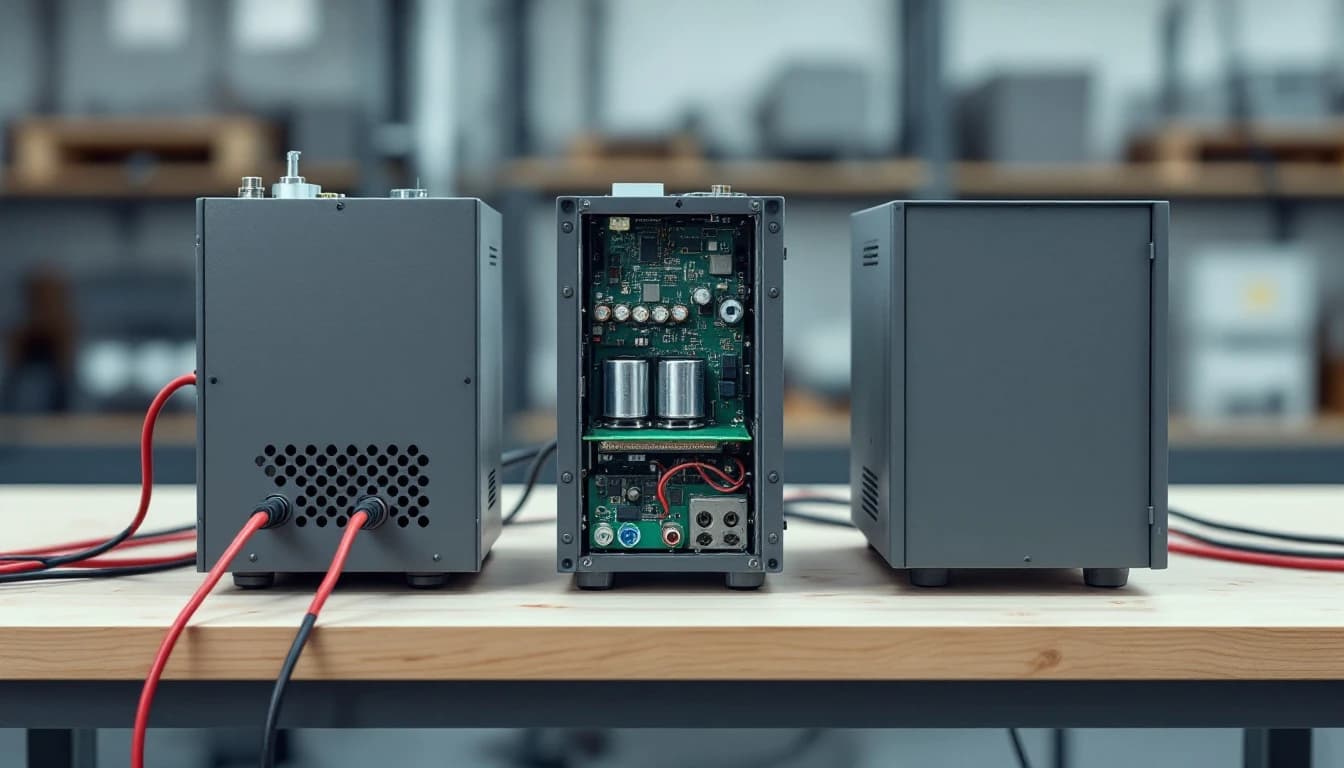
In an Allen-Bradley power supply catalog number, the prefix names the platform — 1746 is SLC 500, 1756 is ControlLogix, 1769 is CompactLogix — and the suffix names the input and the capacity. "PA" means AC input and "PB" means 24 V DC input on the 1756 and 1769 lines; on the SLC line, P1, P2 and P4 are AC units of rising capacity and P3 is the 24 V DC version. You can usually substitute upward in capacity within the same input type. You can never substitute across input types, and on the SLC units a voltage jumper set wrong will destroy the replacement in the first second.
This is a reference page for the person holding a dead supply and a parts catalogue. It decodes the families, lists what is safe to swap, says where each platform sits in its lifecycle, and gives the repair figure — a flat $349 for every rack supply on this page.
The catalog table
As of October 2026 these are the supplies we see most, with their published ratings. Ratings are from Rockwell's selection data; check the installation instructions for the series letter on your label, because some figures changed between series.
| Catalog number | Platform | Input | 5 V backplane capacity | Our repair |
|---|---|---|---|---|
| 1746-P1 | SLC 500 | 120 / 240 V AC, jumper-selected | 2 A | Flat $349 |
| 1746-P2 | SLC 500 | 120 / 240 V AC, jumper-selected | 5 A | Flat $349 |
| 1746-P3 | SLC 500 | 24 V DC | 3.6 A | Flat $349 |
| 1746-P4 | SLC 500 | 120 / 240 V AC, jumper-selected | 10 A | Flat $349 |
| 1756-PA72 | ControlLogix | 85–265 V AC, auto-ranging | 10 A | Flat $349 |
| 1756-PB72 | ControlLogix | 24 V DC | 10 A | Flat $349 |
| 1756-PA75 | ControlLogix | 85–265 V AC, auto-ranging | 13 A | Flat $349 |
| 1756-PB75 | ControlLogix | 24 V DC | 13 A | Flat $349 |
| 1769-PA2 | CompactLogix | 120 / 240 V AC | 2 A | Flat $349 |
The flat price covers component-level repair of the rectifier, switching stage, capacitors and fan, a full electrolytic recap where ageing is found, and a load test at rated output with ripple and regulation verified before the unit comes back. It carries a 24-month warranty. Standard turnaround is 3–5 business days in lab, and rush service is $149 for 1–2 business days.
Reading a 1746 number: the SLC 500 family
The SLC 500 modular chassis takes its supply on the left-hand end of the rack. The number after the P is a model, not a wattage, so the sequence has to be learned rather than deduced.
- 1746-P1 — the small AC supply. Enough for a short rack of discrete I/O.
- 1746-P2 — the workhorse. The same AC input as the P1 with two and a half times the 5 V capacity, and by a distance the unit we repair most.
- 1746-P3 — the 24 V DC input version, for panels that run on a DC control bus or a battery-backed supply.
- 1746-P4 — the high-capacity AC unit for full racks heavy with analog and specialty modules. It is physically larger than the others, so check panel clearance before treating it as a drop-in.
- 1746-P5, P6 and P7 — DC-input variants for other station voltages: nominally 125 V DC, 48 V DC and a 12/24 V DC unit respectively. Less common, mostly in utility and mobile applications.
The jumper. The AC units — P1, P2 and P4 — are not auto-ranging. A jumper on the supply selects 120 V or 240 V operation. A unit set for 120 V and connected to 240 V fails immediately and often takes its input stage with it. A surprising number of "dead on arrival" replacement supplies are healthy units that were fitted with the jumper where the last panel left it. Check it before you apply power, every time, including on a unit that comes back from repair.
Lifecycle. The SLC 500 platform is in the late stages of its life. Rockwell has been moving 1746 and 1747 catalog numbers through its discontinuation phases and directs users to CompactLogix as the migration path; check the product lifecycle status for your exact catalog number, because individual modules have moved on different dates. In practice that means the supply on your rack is likely the same age as the rack, and new stock is not something to plan around.
Reading a 1756 number: ControlLogix
ControlLogix supplies also mount on the left end of the chassis, and here the suffix does decode cleanly.
- P — power supply.
- A or B — the input: A for AC, B for 24 V DC. There are also C and H versions for 48 V DC and 125 V DC station supplies.
- 72 or 75 — the capacity class. Both deliver the same total backplane power; the 75 raises the 5 V current from 10 A to 13 A.
- R suffix — the redundant versions, 1756-PA75R and 1756-PB75R, which are used in pairs with a chassis adapter module rather than mounted directly on the rack.
Unlike the SLC units, the 1756 AC supplies are auto-ranging across 85–265 V AC, so there is no jumper to get wrong. What there is instead is a series letter. Rockwell has revised these supplies over their production life, and the ratings on individual backplane rails differ by series. If you are loading a chassis close to its limit, the series on the label matters as much as the catalog number.
The ControlLogix platform is current, so this is a different conversation from the SLC one: new supplies can be bought. The reason a plant repairs one anyway is usually time — a repair is a few days, a purchase order through a distributor is whatever the lead time happens to be that month — or the wish to keep a proven spare on the shelf.
Reading a 1769 number: CompactLogix
CompactLogix and MicroLogix 1500 expansion use the 1769 supplies, and they follow the same letter logic as the 1756 line: PA is AC input, PB is 24 V DC, and the trailing digit is the capacity class — 2 for the 2 A units, 4 for the 4 A units.
The 1769 system has one rule the rack-based platforms do not. The supply sits within the bank of modules rather than at the end of a chassis, and every 1769 module has a power-supply distance rating — the maximum number of slots it may sit from the supply. Some modules must be within four positions; many allow eight. A bank that worked for years can develop intermittent faults after someone adds modules to the far end, and the power supply is then blamed for a layout problem.
What substitutes for what
The safe rules, stated plainly.
- Upward in capacity, same input type, same platform: generally yes. A 1746-P2 will do the job of a 1746-P1. A 1756-PA75 will generally stand in for a 1756-PA72. Confirm chassis compatibility in the installation instructions, and check physical size on the P4.
- Downward in capacity: only after doing the arithmetic. Add up the backplane current every module in the rack draws at 5 V and at 24 V, and compare it with the supply's rating on each rail. A rack that ran on a P2 may or may not run on a P1.
- Across input types: never. An AC supply is not a DC supply. The connector fits; the result is a failed unit.
- Across platforms: never. A 1746 supply does not fit a 1756 chassis, electrically or mechanically.
- Used for used: with your eyes open. A used supply of the same vintage has the same aged capacitors as the one that just failed.
That last point is the heart of the repair case. The rule of thumb for electrolytic capacitors is that every 10 °C of sustained temperature rise roughly halves their service life, so a supply that spent fifteen years at the top of a warm enclosure has aged on a different clock from one in an air-conditioned control room — and a surplus unit comes with no record of which life it led.
"We kept three used P2s on the shelf and felt well covered. First time we needed one, two of the three would not hold up a full rack once the cabinet warmed up. Spares you have not load-tested are not spares, they are a hope."
— Plant maintenance supervisor, 18 years, plastics injection molding; name withheld by request
How these supplies fail
Rack power supplies are among the most repairable items in a control cabinet, because they fail in a small number of well-understood ways.
Aged output filter capacitors. The classic. The supply still starts, but ripple rises and the 5 V rail sags under load. The symptoms are indirect: processor faults, modules dropping out, a rack that runs cold and faults warm.
Rectifier and input-stage failure. Usually after a line event. The rack is simply dark.
Fan failure and heat death. Where the unit has a fan, a stopped fan cooks everything downstream of it over months.
Start-up failure when warm. A supply that will not restart after a brief power dip until it has cooled is telling you its start-up capacitors are finished.
The symptom that sends most of these to us is a rack that has gone completely dark, and the supply is the right first suspect — the reasoning is laid out in PLC rack dead? Check the power supply first. When the rack is lit but individual modules are faulting, ControlLogix module fault LEDs is the better starting point.
Check before you pull it
Three checks, none of which needs the supply out of the rack.
Measure the input at the supply's own terminals. Not at the breaker, at the terminals. A blown control fuse or a loose neutral is cheaper than any repair.
Read the power indicator. A dark indicator with good input voltage is a failed supply. A lit indicator with a faulted processor is a different problem.
Pull modules one at a time. A shorted I/O module can pull the backplane down and make a healthy supply look dead. If the supply comes up with a module removed, that module is your fault.
Do all of it under lockout. OSHA estimates that compliance with its control-of-hazardous-energy standard (osha.gov) prevents around 120 fatalities and 50,000 injuries a year, and that workers injured in such incidents lose an average of 24 workdays. Voltage checks at live terminals are energized work under NFPA 70E (nfpa.org), which draws the arc-flash boundary at an incident energy of 1.2 cal/cm². Industrial control panels are built to UL 508A (ul.com), and a field substitution that changes a supply's input type or rating is a change to that panel worth documenting.
Repair, replace or spare
For the SLC supplies the decision is easy: new stock is not a plan, used stock is a gamble, and a $349 repair returns a load-tested unit with new wear components. For the ControlLogix and CompactLogix supplies a new unit is available, and repair wins on time and on the chance to build a tested spare out of the unit you already own.
If we cannot repair a flat-price unit, the repair price is refunded in full less return shipping. If the supply tests fully functional on load — which happens, because a dark rack is sometimes a fuse — a $95 test-and-verify fee applies and the balance is refunded, and you have ruled out the supply for the price of a bench hour.
The wider economics are not subtle. NIST research on manufacturing maintenance (nist.gov) put U.S. machinery maintenance spending at roughly $50 billion a year in its industry study, and federal producer price data for machinery and equipment (bls.gov) has run ahead of the general index for several years. A rack supply is one of the cheapest components in a line and one of the few that stops all of it.
For where this sits among other supply types see industrial power supply repair cost, and for processors and I/O on the same racks, PLC repair cost. The full list is on our industrial power supply repair page, and individual catalog numbers are searchable under parts. When you are ready, start a repair.
Frequently asked questions
What is the difference between a 1746-P1 and a 1746-P2?
Capacity. Both are AC-input SLC 500 rack supplies with the same jumper-selected 120/240 V input, but the 1746-P1 supplies 2 A on the 5 V backplane rail and the 1746-P2 supplies 5 A. A P2 can replace a P1; a P1 can replace a P2 only if the rack's total module current fits inside the smaller rating.
Can I replace a 1756-PA72 with a 1756-PA75?
Generally yes. Both are auto-ranging AC supplies for the ControlLogix chassis with the same total backplane power, and the PA75 provides more 5 V current — 13 A against 10 A. Confirm chassis and series compatibility in the Rockwell installation instructions before fitting it.
What does the B mean in 1756-PB72?
It means 24 V DC input. In the 1756 and 1769 lines, PA is an AC-input supply and PB is a 24 V DC-input supply. They are not interchangeable: fitting an AC supply where the panel provides DC, or the reverse, destroys the unit.
Why did my replacement SLC 500 power supply fail immediately?
Most often because of the input voltage jumper. The 1746-P1, P2 and P4 are not auto-ranging; a jumper selects 120 V or 240 V. A supply jumpered for 120 V and connected to 240 V fails at once. Check the jumper against the panel's supply voltage before applying power to any replacement or repaired unit.
How much does it cost to repair an Allen-Bradley PLC power supply?
A flat $349 for the SLC 500, ControlLogix and CompactLogix rack supplies listed here, including parts, a load test at rated output and a 24-month warranty. If the unit cannot be repaired the price is refunded less return shipping, and if it tests fully functional a $95 test-and-verify fee applies with the balance refunded.
Is it worth repairing a supply for an obsolete SLC 500 rack?
Yes, in most cases. The SLC 500 platform is in its discontinuation phases, so new supplies are not a dependable source and used ones carry the same aged capacitors as the failed unit. A repair replaces the wear components, proves the unit on load and costs far less than migrating the rack to a new platform.
How do I know the power supply is actually the problem?
Check three things first: input voltage at the supply's own terminals, the supply's power indicator, and whether the rack comes up with modules removed one at a time. Good input with a dark indicator points to the supply. If you are still unsure, send it — a unit that tests good costs only the $95 test-and-verify fee.
Have this exact problem?
Start a repair or get a free technician review — we'll tell you honestly whether it's worth fixing.